There is a table at Café Naderi in Tehran that I have never been able to walk past casually.
Naderi is one of the last of its kind — a European-style café on Jomhouri Avenue that has outlived nearly everything around it. In the 1930s, a small group of writers used to gather there, and their center of gravity was a thin, bespectacled man with a civil servant’s job and a mind full of ruin: Sadegh Hedayat. He wrote The Blind Owl there, or near there, or in the atmosphere that place made possible. Waiters brought coffee. The conversation went where it went. Nobody in that room knew they were sitting inside what would become the founding scene of modern Persian prose.
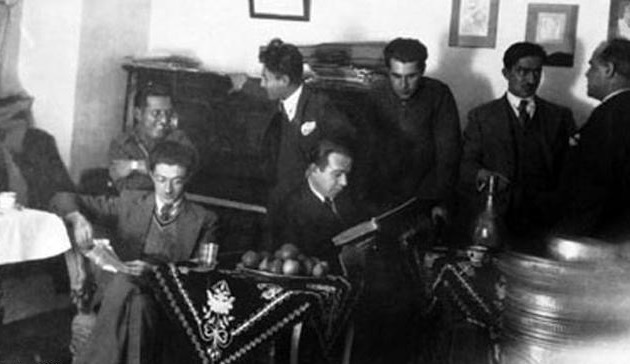
I have sat at Naderi. I have looked at the chairs. And every time, the same useless, irresistible thought: what would he say?
In July I was in Paris, staying in the 5th, and I went to Père Lachaise to find him.
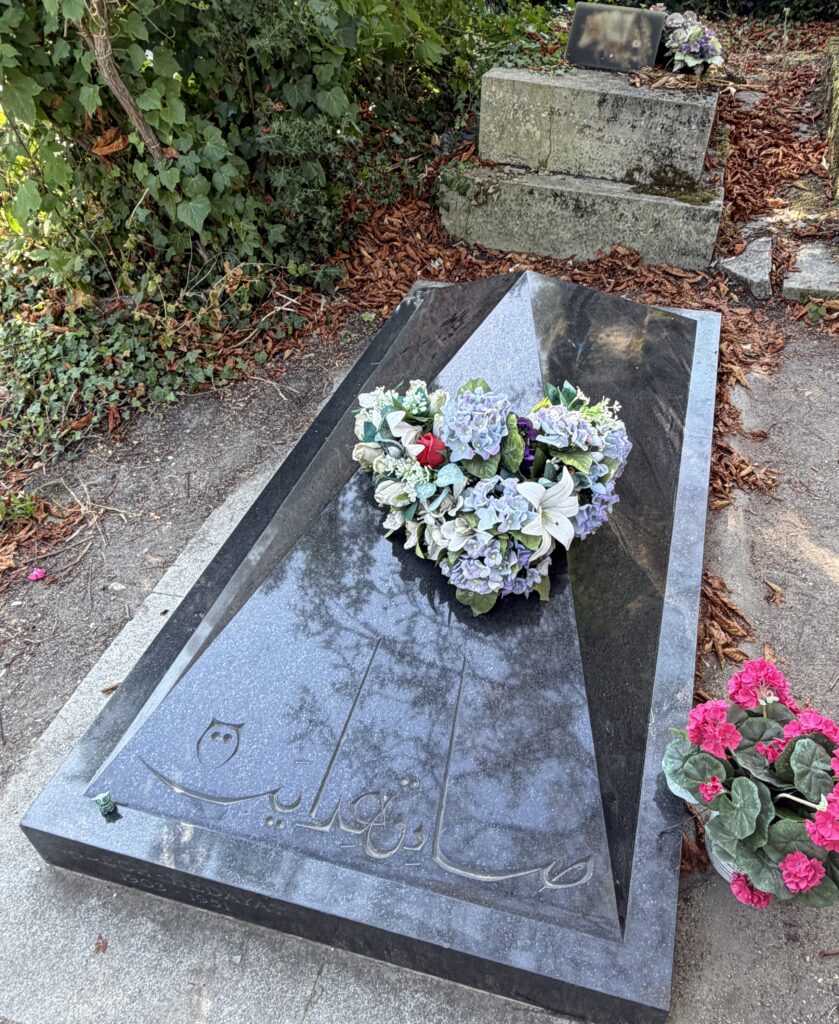
Hedayat is buried at Père Lachaise, Division 85. The stone is modest. People leave things on it — flowers, sometimes a cigarette, occasionally a copy of the book. There is usually an owl somewhere, left by someone who understood the reference, in the picture if you zoom in, you can see my owl, tiny, that traveled with me from Iran to US to France and now here, nine time zones from Naderi.
A few days later I walked to Montparnasse, which is a different cemetery with a different weather to it, and found Sartre and Beauvoir. They share a slab. Their names are on the same stone, one above the other, and the marble is covered in métro tickets and lipstick kisses and pebbles — a habit that has followed that grave for decades. Two people who spent years arguing about freedom, ending up in a single plot, permanently annotated by strangers.
I added my other favorite writers and thinkers to Liminal, Friedrich Nietzsche, Albert Camus, Hunter S Thompson, whose book I translated to Farsi and many more…
The Oldest Wish in Literature
The wish to talk to them is not original. It may be the least original wish there is, which is exactly why it keeps working.
Dante wanted a guide, so he got Virgil — a poet thirteen centuries in the ground, walking him downhill and explaining things. Midnight in Paris is a man who cannot stop wanting the dinner party he was born too late for …
What Liminal Is
Liminal: The Atrium is an app about that gap.
An atrium is not a room you stay in. It’s the space you pass through on the way somewhere — a threshold, which is what liminal means. That name is the whole argument. You are not being offered a resurrection. You are being offered a doorway, and a bench, and a conversation that lasts as long as you want it to and then ends.
You choose a thinker. You ask them something. What comes back is a response built from, inspired from, how that person actually wrote and argued — their preoccupations, their blind spots, their habits of mind, their bad moods. You can push back. They will push back at you. You can ask Hedayat what he thinks the owl was. You can ask Sartre whether bad faith is a useful category for a person managing a career, or whether it’s just a stylish way of calling someone a coward. You can ask them things you would never ask a person who could be hurt by the question.
The app is free to download. Conversations run on credits, because live model responses cost real money and I would rather charge honestly for compute than run ads against Sadegh Hedayat.
The Part I Refuse to Oversell
Here is what Liminal is not: it is not Hedayat. It is not a channel, a medium, a séance, or a recovery. There is no version of this technology that gives you the man. The man is in Division 85 and he is not coming back, and any product that implies otherwise is selling you something it does not have.
Because the thing I wanted at that table in Naderi was never a ghost. It was the experience of having my question meet resistance. Of saying something to Hedayat and having something come back that was shaped like him and not like me — something I hadn’t already thought, in a voice I couldn’t have produced. That’s not communion. It’s closer to a good argument with a well-read friend who happens to have spent a lot of time in a specific person’s sentences.
The Atrium is open. Come ask them something.
Liminal — The Atrium
A hall of doors. Behind each one, a mind.
A philosophy game. Nineteen thinkers — Marcus Aurelius, Nietzsche, Rumi, Hafez, Simone de Beauvoir, and more — reconstructed from their writings, each with a chamber of games and conversation. Ask a real question and watch a mind think it through; set two voices against each other; draw an omen from the Oracle. On iPhone, iPad, and Mac — or in the browser.
Leave a Reply