Two apps, two mountains, and the question of what a day is for
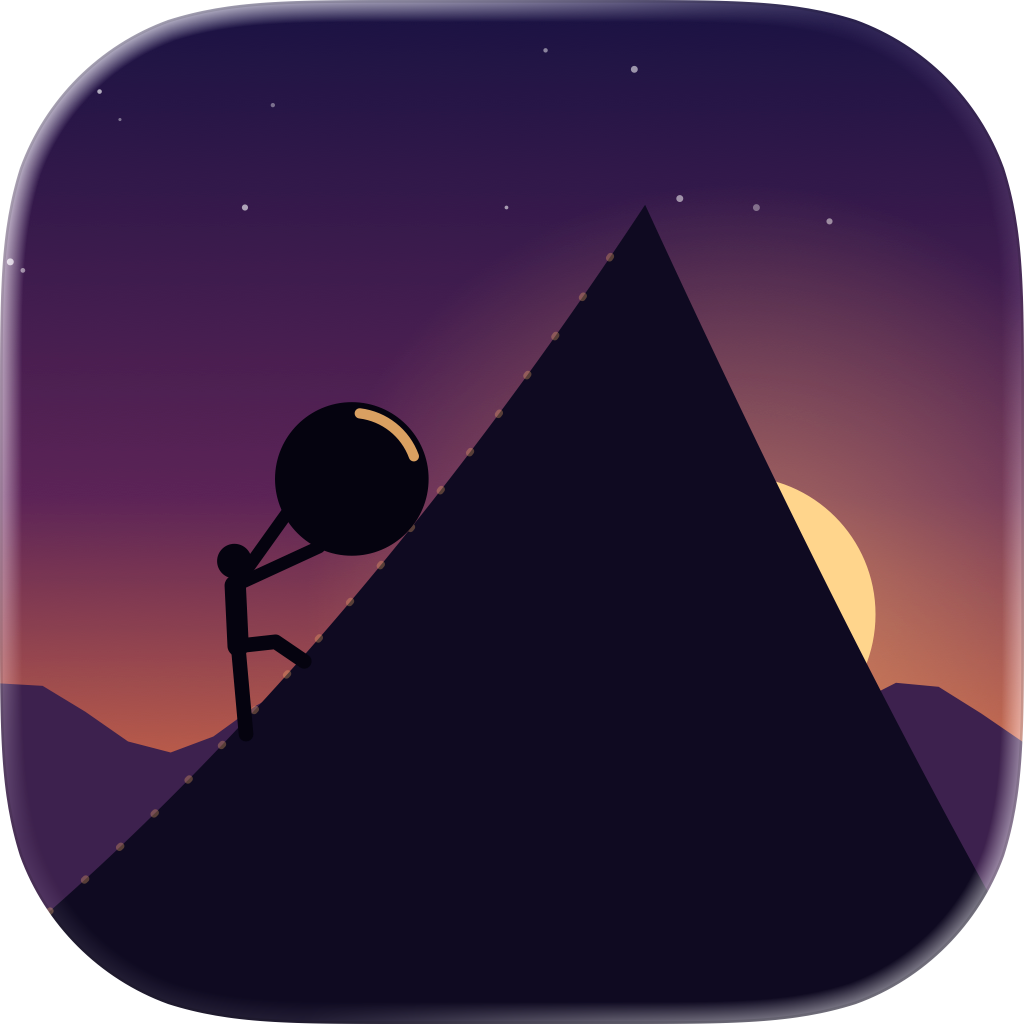
The inbox refills. The dishes come back. The laundry basket is never done being a laundry basket!
I built two apps this year that live on either side of that sentence. One of them is about the work that returns no matter what you do. The other is about the work that never returns — the single day, unrepeatable, that you either fill with something or don’t.
They come from two different civilizations and two different centuries. They’re solving the same problem.
The absurd, briefly
Albert Camus published Le Mythe de Sisyphe in 1942, in occupied France.
The absurd, for Camus, is not a property of the universe. It’s a relationship. On one side, a human being who demands that things make sense. On the other, a world that is silent about it. Neither is absurd alone. The absurd is the gap — the friction of a meaning-seeking creature living in a meaning-indifferent world.
He rules out two escapes. You can’t kill yourself, because that abolishes one side of the relationship and settles nothing. And you can’t take the leap into a system — religious, ideological, political — that dissolves the gap by decree, because that’s what he calls philosophical suicide: buying peace with the one thing you actually own, which is your clear sight.
What’s left is the third option: live in the gap, with your eyes open. Camus calls this revolt. Not rebellion against anything in particular — just the refusal to stop looking.
Sisyphus is the figure he chooses for it. Condemned by the gods to roll a stone up a hill forever, watching it roll back every time. The gods had reasoned, Camus notes, that futile and hopeless labor is the worst punishment available. They may have been right about the labor. They were wrong about the man.
Sisyphus’s happiness is not granted by the gods, deserved by the work, or waiting at the top. It’s the position he takes toward a fate he can’t change. His scorn — Camus’s word — is what turns the sentence into a life.
Why this is a productivity problem
So the standard productivity app quietly teaches you that your actual life — the recurring, returning, never-finished part of it, which is most of it — is a failure state. A backlog. Something you’d be free of if you were only better organized. That’s not a scheduling problem. That’s a metaphysics problem, and it’s the wrong metaphysics, and you feel the wrongness every evening at eleven o’clock.
Camus’s move is to refuse the premise instead of optimizing inside it. Don’t get better at finishing. Change what the repetition means.
That’s what Sisyphus: Push Gladly is.
⸻
Sisyphus: Push Gladly
You name your boulders — the pieces of your work that always come back. You push them up the mountain each day. You reach the summit by evening. At midnight you lose everything, and tomorrow you come back and do it again.
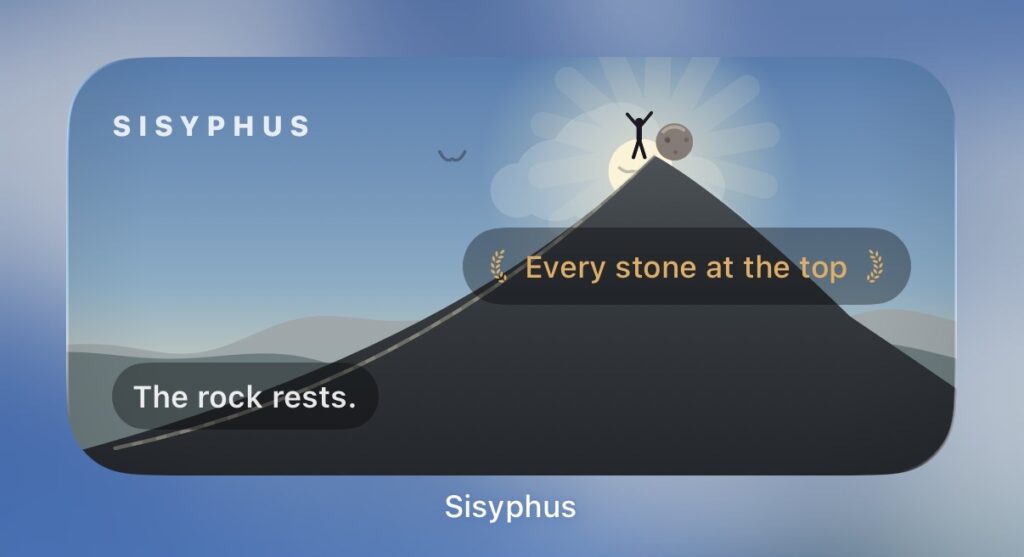
That’s the whole app. The design decisions all follow from taking Camus seriously rather than decoratively.
Pushing costs something. You don’t tap a checkbox; you hold the stone. A ring fills, a rumble builds under your finger, stone grinds on stone, and the push lands with a thud. Effort should feel like effort. A checkbox is a lie about labor.
The mountain is alive and it is yours. The scene is drawn in code, not stock art. The sky follows your real clock — dawn breaks, dusk burns, stars wheel past a crescent moon. The seasons follow your calendar: snow in January, wildflowers in April, amber leaves in October. And the man with the rock stands exactly as far up the slope as your day’s labor has taken him.
The mountain remembers, even though the day doesn’t. Every forty pushes raises a cairn beside the trail. The path itself wears deeper over your first two months. A year in, your mountain looks lived-on, and nobody else’s looks like yours. This is the honest form of progress in a life of recurrence: not a finish line, but a landscape shaped by having been walked.
Rest is part of the practice. No streak-shaming. Declare a rest day and the mountain rests with you.
⸻
Pendar-e Nik
Three thousand years ago, in the language that would become mine, Zarathustra folded an entire ethic into three words:
Pendar-e Nik. Goftar-e Nik. Kerdar-e Nik.
Good thoughts. Good words. Good deeds.
It’s a practice — a daily accounting in three columns, thought, speech, action, with no way to substitute one for another. You can’t think your way out of owing a deed. You can’t do good works and skip what you said.
And it takes seriously something modern productivity tools have no vocabulary for at all: that a well-kept mind and an honest sentence are work, and they count.
So Pendar-e Nik asks you for all three, once a day. Write one good thought you kept, one good word you spoke, one good deed your hands did. That’s it. Three lines.
→ Pendar-e Nik on the App Store
How to make a day unique
Put the two side by side and you get something neither has alone.
Sisyphus handles the boulders. It takes the recurring, unfinishable mass of your obligations and stops treating it as a backlog you’re failing to clear. It’s the part of the day that is the same, held well.
Pendar-e Nik handles the margin. Three offerings that were not on anyone’s list, that no one assigned, that recur only in form and never in content. It’s the part of the day that is only today.
Do that for a year and you have something no analytics dashboard can give you: not a record of what you completed, but a record of what you were, three hundred and sixty-five times, in your own words.
Push gladly. Tend well.
Again tomorrow.
Leave a Reply