Futures Thinking for IT Leaders
We are not trained to think about the future. We are trained to optimize the present.
Futures studies offers a different discipline — one that connects technology,
governance, and values into a single lens for navigating uncertainty.
There is a question that technology leaders rarely ask, and it may be the most important one: not what is likely to happen, but what is possible? Not what our current trajectory predicts, but what range of futures could emerge — and which of those futures do we actually want to build toward?
This is the domain of futures studies — a discipline that has existed for decades in policy, defense, and urban planning circles, but has barely touched IT leadership. That is a significant gap. Because the conditions under which technology leaders now operate — overlapping crises, accelerating change, the collapse of assumptions that held for years — are precisely the conditions futures thinking was designed to address.
Why IT Leaders Need Futures Thinking
Most technology organizations are trained to optimize for the probable. We build roadmaps based on current trends. We forecast budgets using last year’s numbers plus a growth multiplier. We plan infrastructure for the workloads we can see. This approach works — until the world changes faster than the roadmap.
A global pandemic reshapes where and how people work. A ransomware attack takes down a hospital system. A geopolitical conflict disrupts the semiconductor supply chain. A large language model arrives seemingly overnight and rewrites the economics of knowledge work. These are not fringe scenarios. These are the actual conditions under which IT leaders have been operating for the last decade. And most of us were not prepared — not because we were incompetent, but because we were trained to optimize for the probable without seriously stress-testing the possible.
Futures studies says: that is not good enough anymore.
Futures studies — sometimes called strategic foresight — is the systematic, interdisciplinary study of possible, probable, and preferable futures. Instead of trying to predict a single outcome, it explores alternative futures, including wild cards and low-probability high-impact events, and examines the worldviews, values, and narratives that shape our collective choices.
The Cone of Possibility
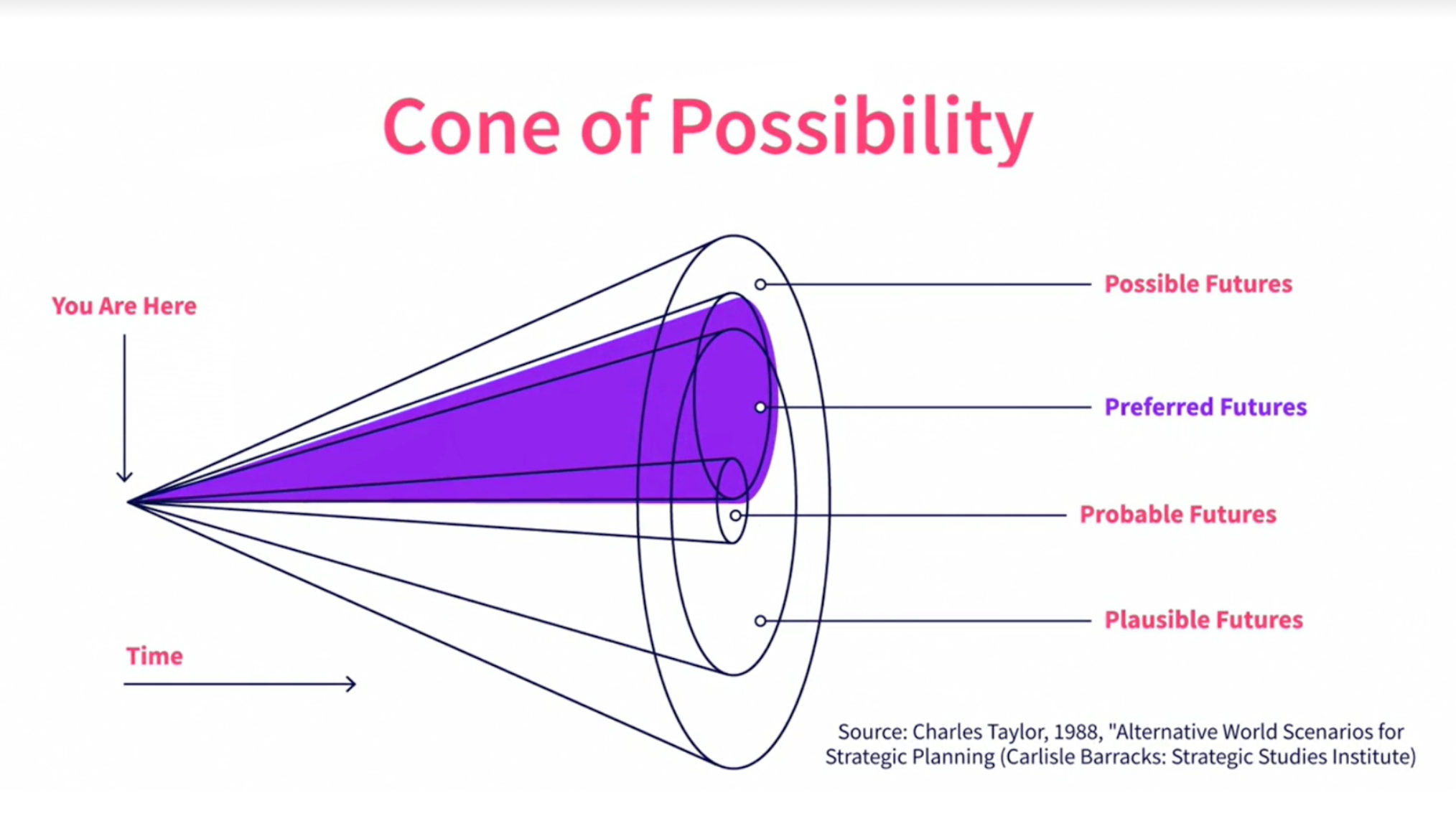
The framework at the heart of futures thinking is the Cone of Possibility — and once you see it, you cannot unsee it.
Imagine you are standing at a single point: the present moment. Now imagine a cone opening outward from where you stand, widening as it extends into time. That widening shape represents the expanding space of different futures that become possible as you move further from now. Inside the cone, there are four distinct layers.
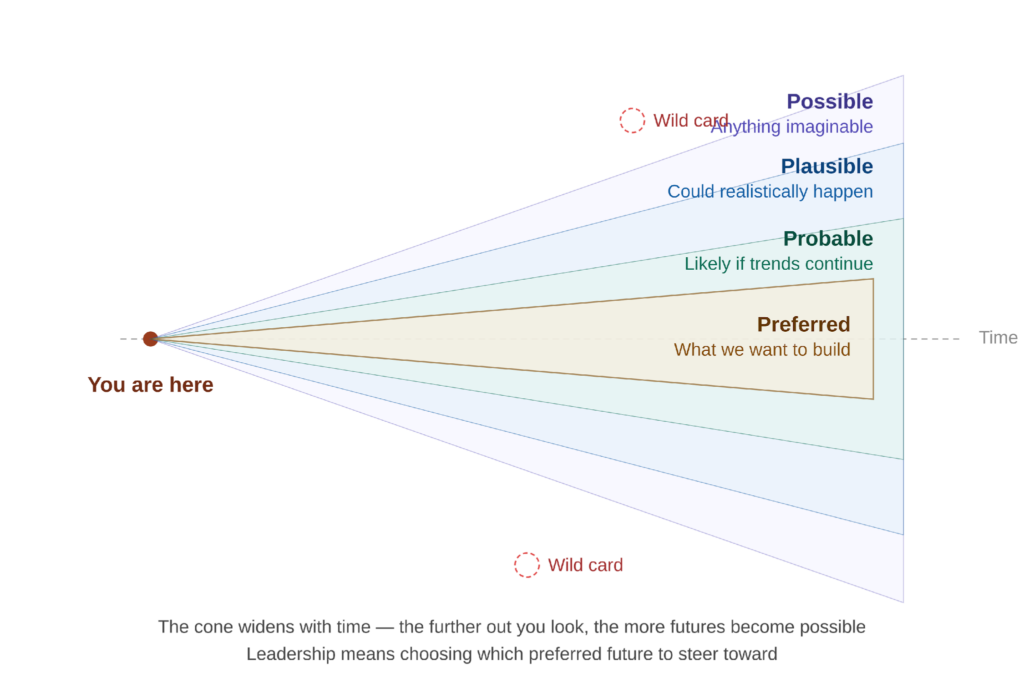
Figure 1: The Cone of Possibility — possible, plausible, probable, and preferred futures widening over time.
Possible futures encompass everything we can imagine that does not clearly break the laws of nature. This is the outermost boundary of the cone.
Plausible futures are those that could realistically happen, given what we know today about trends, systems, and constraints. The signals are already present; the question is whether they converge.
Probable futures are what is likely to occur if current trends and power structures continue without major disruption. This is where most planning happens — and where most planning fails when disruption arrives.
Preferred futures are the futures we actually want to move toward, based on our values, aspirations, and ethical choices. This is where leadership becomes philosophy.
Through an IT lens, the probable future for most technology organizations — if nothing changes — is more complexity, more technical debt, more reactive firefighting, and slower strategic alignment with the business. The plausible future might look like AI handling tier-one support entirely, with teams pivoting to governance and orchestration. The possible future includes scenarios that feel unlikely today but carry enormous consequences: a significant cyber conflict, a regulatory shift that forces entire data architectures to be rebuilt, a talent exodus driven by burnout and displacement.
And the preferred future? That is the question only you can answer. What kind of organization do you want to build? What role do you want technology to play in your organization’s relationship with its people and its mission? The cone does not just tell you where you might end up. It asks you to decide where you want to go — and then reverse-engineer your way there.
The Limits of Forecasting
One of the core challenges of futures thinking is that we are not very good at prediction. Many confident forecasts about technology, society, and business have turned out to be dramatically wrong. There is a wonderful and humbling collection from the Public Domain Review — illustrations from the 19th century depicting what the year 2000 would look like. Personal aircraft. Automated school machines. They got some things right and missed spectacularly on others.
The point is not that forecasting is useless. The point is that future developments always rest on layers of assumptions about how things are interconnected, what actors’ objectives and interests are, and what the world is actually like. It is necessary to critically assess such assumptions and highlight the prevailing beliefs that shape our planning.
This is why futures studies emphasizes diverse voices and perspectives. Only a plurality of experiences and disciplines can help us see the blind spots in our thinking and challenge the default narratives we carry about what is possible or desirable.
Technology as a Way of Revealing
Heidegger wrote about technology not as a neutral tool, but as a way of revealing the world. Technology does not just solve problems — it shapes what we see as problems. It shapes what we consider possible. It shapes what we value.
When we build IT systems — when we choose a vendor, design an access control model, decide what gets monitored and what does not — we are making philosophical choices. We are deciding what kind of world we are helping to build. Technology can amplify openness, participation, and trust. It can also amplify polarization, enable surveillance, and undermine institutional integrity. The difference is not in the technology itself, but in the values and governance frameworks that surround it.
Futures studies gives us the language to make these choices consciously, rather than drifting into them by default.
Three Practical Tools
Philosophy without tools is conversation at a dinner party. The futures studies field offers concrete methods that technology leaders can start using immediately.
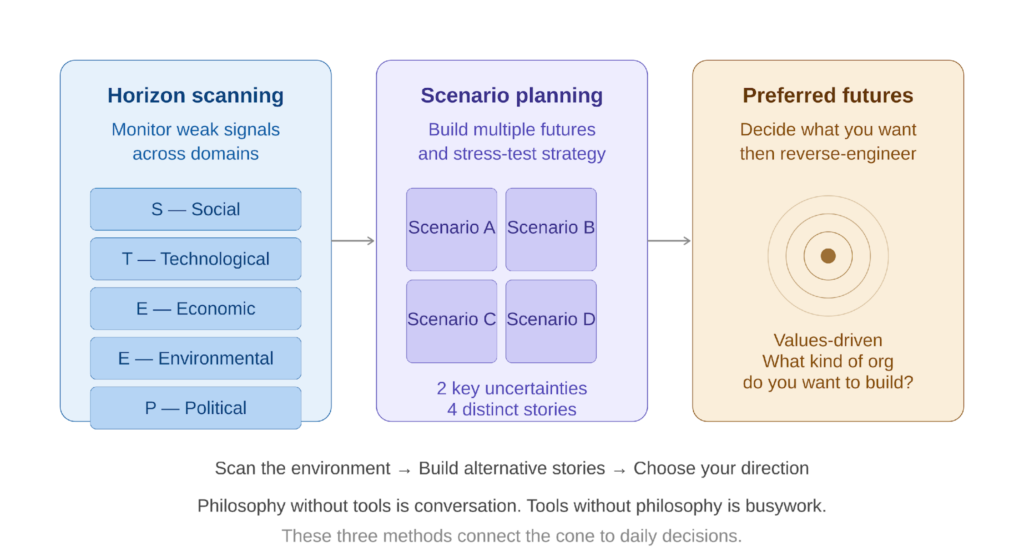
Figure 2: Horizon scanning, scenario planning, and preferred futures mapping — from signals to strategy to values.
Horizon scanning is the practice of systematically monitoring weak signals — early, ambiguous indicators of emerging change — across multiple domains. The STEEP framework (Social, Technological, Economic, Environmental, Political) maps how trends interact and identifies where early signals emerge. In practice, this means reading across your normal domain: policy journals, economic reports, sociological research. Understanding how birth rate trends affect your future talent pipeline. How energy costs affect your data center economics. How shifts in privacy regulation reshape your architecture decisions.
Scenario planning is the practice of constructing multiple, distinct, internally consistent stories about what the future might look like — and then stress-testing your strategy against each one.
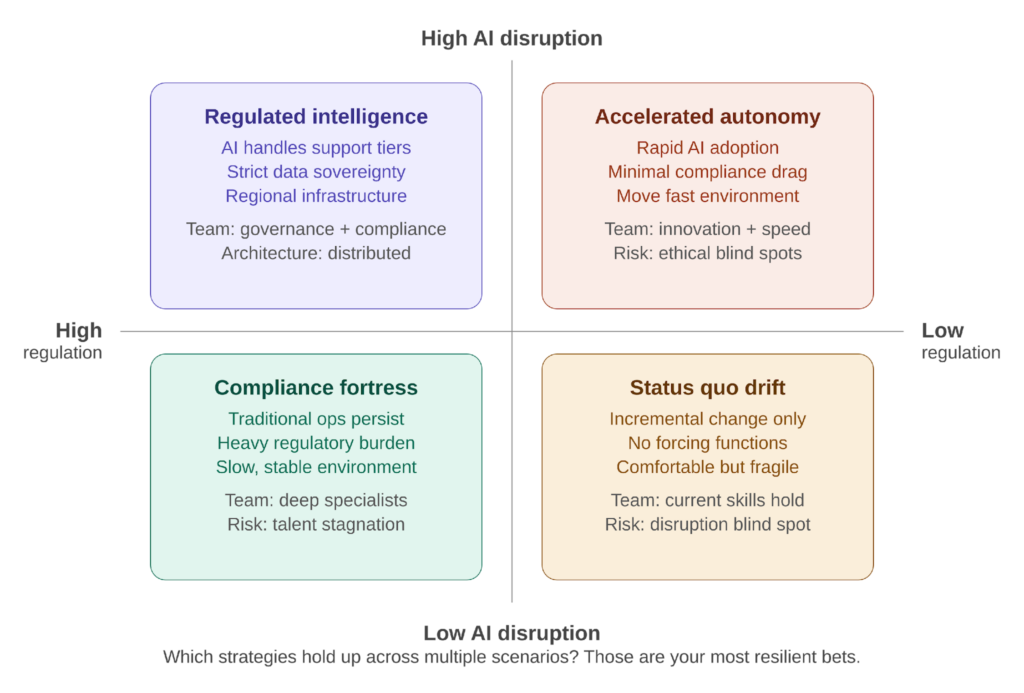
Figure 3: A scenario matrix built from two key uncertainties — AI disruption and regulatory pressure.
Pick two key uncertainties facing your organization over the next five years. Build four scenarios from their combinations. Each scenario implies different strategies, different hiring profiles, different vendor relationships, different architecture decisions. Which strategies hold up across multiple scenarios? Those are your most resilient bets.
Preferred futures mapping is the most overlooked tool and the most powerful. It starts with a deceptively simple question: what kind of organization do we want to be in ten years? Not what do we think we will be. Not what market forces are driving us toward. What do we want? What are our values? What does success look like for the humans in and around this organization — not just on a balance sheet, but in lived experience?
Thrownness and Projection
We live in what the World Economic Forum describes as a landscape of overlapping crises, where geopolitical fragmentation, technological acceleration, and social polarization interact in complex ways.
Heidegger called the fundamental challenge of existence thrownness — the idea that we are thrown into a world we did not choose, at a time we did not choose, into conditions not of our making. We do not get to pick when the next pandemic arrives, or when the next vulnerability is disclosed, or when the next regulatory wave reshapes our industry.
But we are not just thrown. We also project. We build. We dwell intentionally. We shape the future that grows from the ground of the present.
The leaders who thrive in uncertainty will not be the ones who optimized hardest for the probable future. They will be the ones who stayed awake to the full cone of possibility. Who built teams and systems flexible enough to pivot when the unexpected arrived. Who had thought about their preferred future clearly enough to make fast, value-aligned decisions when the moment demanded it.
That is the invitation of futures studies. And it is the invitation of leadership itself.
Leave a Reply