
What HSRP Teaches Us About Redundancy, Succession, and Designing for Continuity
The best redundancy is invisible.
When the active fails and the standby takes over, the hosts notice nothing.
Every device on your network has a default gateway — a single IP address it sends all outbound traffic to. When that gateway is up, everything works. When it goes down, everything stops. Not gracefully. Not with a warning. Everything just stops.
This is one of the most fundamental single points of failure in networking. And the solution, developed by Cisco decades ago and still running in production networks worldwide, is a protocol called the Hot Standby Router Protocol, or HSRP. It is elegant in its simplicity, profound in its implications, and — if you let it — a remarkably useful lens for thinking about leadership, succession, and organizational resilience.
The Problem: One Gateway, One Failure
In any network, hosts need a default gateway to reach anything outside their local subnet. That gateway is typically a router. If you have only one router performing this function and it fails, every host behind it loses connectivity. Not because their own network is down, not because the destination is unreachable, but because the one device responsible for forwarding their traffic is gone.
The obvious answer is to add a second router. But here is the problem: every host on the network is configured with a single default gateway IP address. If Router 1 fails and Router 2 has a different IP address, every host would need to be reconfigured to point to Router 2. In a network with hundreds or thousands of devices, that is not a failover — that is a catastrophe management exercise.
HSRP solves this by introducing a concept that is deceptively simple and deeply powerful: the virtual router.
The Virtual Router: The Role Versus the Individual
In an HSRP group, two or more physical routers cooperate to present the illusion of a single virtual router. They share a virtual IP address and a virtual MAC address that no physical router actually owns. Hosts configure this virtual IP as their default gateway. They do not know — and do not need to know — which physical router is actually forwarding their traffic.
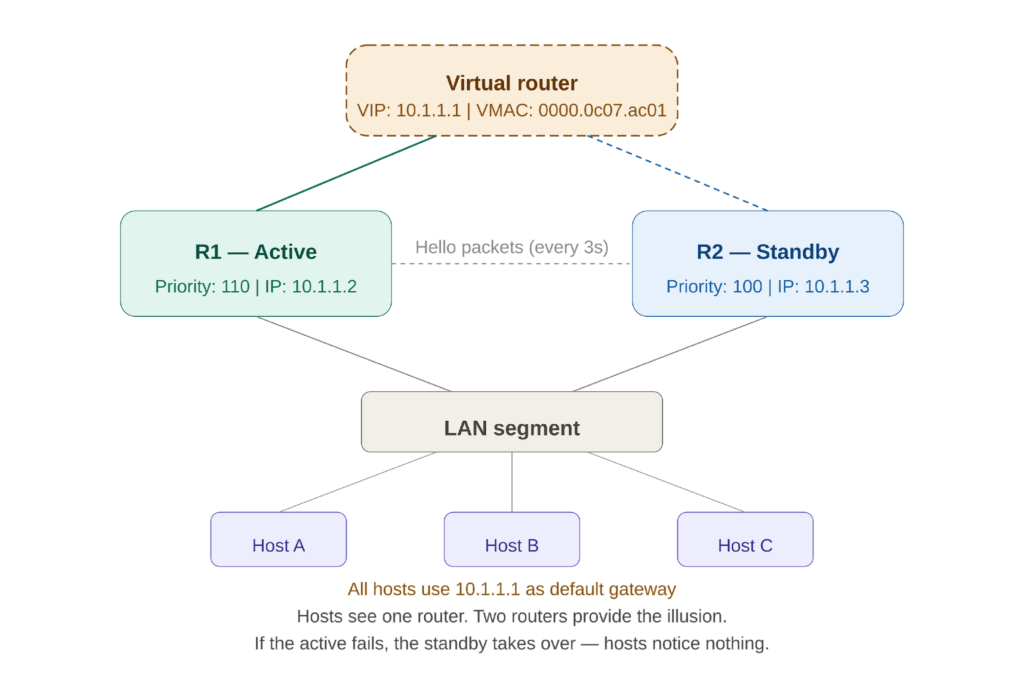
Figure 1: Two physical routers sharing a virtual IP address. Hosts see one gateway. Two routers provide the service.
One router is elected as the active router — it does the actual forwarding. Another is elected as the standby router — it monitors the active, ready to take over at any moment. The election is based on priority: the router with the highest configured priority wins. If priorities are equal, the router with the highest IP address becomes active. The default priority is 100.
The active and standby routers communicate through hello packets, sent by default every three seconds. The active router says: I am here, I am healthy, I am still forwarding. If the standby router misses three consecutive hello packets — a ten-second hold time by default — it concludes that the active has failed and takes over.
The transition is seamless. The standby router assumes the virtual IP and MAC address. It sends a gratuitous ARP to update the network’s address tables. And the hosts continue sending traffic to the same gateway address they have always used. They notice nothing.
Failover: Continuity by Design
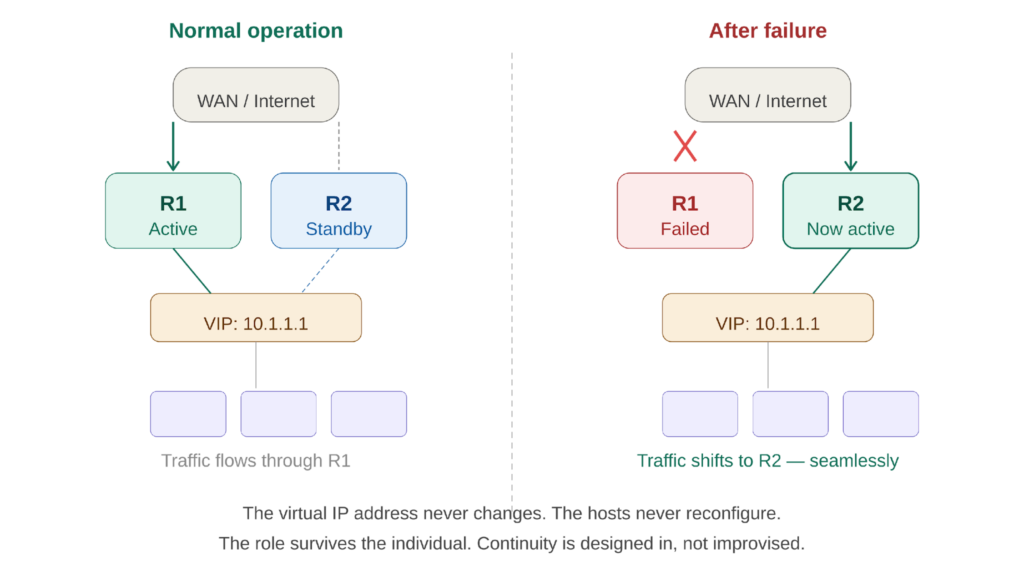
Figure 2: When the active router fails, the standby takes over. The virtual IP never changes. The hosts never reconfigure.
This is the core insight of HSRP, and it is worth sitting with: the role survives the individual. The virtual IP address is the role. The physical routers are the individuals who fill it. When one individual fails, another steps in, and the role — the function that the rest of the system depends on — continues without interruption.
HSRP also supports interface tracking, which adds situational intelligence to the failover decision. A router can be configured to monitor the state of its upstream WAN link. If that link goes down, the router’s HSRP priority is automatically reduced — even though the router itself is still running. This can trigger a failover to the standby router, which may have a healthy upstream path. The system does not wait for a complete failure to act. It responds to degraded conditions proactively.
Preemption: The Question of Return
There is a subtle but important feature in HSRP that reveals a deep design philosophy: preemption. By default, preemption is disabled.
What this means is: if the original active router fails, and the standby takes over, and then the original router recovers and comes back online with a higher priority — it does not automatically reclaim the active role. It joins the group as the new standby. The current active router continues forwarding.
Why? Because stability matters more than hierarchy. The failover already happened. Traffic is flowing. The network has settled into a new steady state. Forcing another transition — even a brief one — introduces risk. The protocol’s default behavior says: recovery is not the same as resumption. Coming back does not mean coming back in charge.
Preemption can be enabled explicitly if you want the higher-priority router to always be active. But the fact that it is off by default tells you something about the protocol’s priorities: minimize disruption, even at the cost of not having the theoretically optimal router in the active role.
Versions and Evolution
HSRP exists in two versions. Version 1, described in RFC 2281 (1998), supports up to 256 groups per interface and uses multicast address 224.0.0.2 for hello messages. Version 2 expanded the group range to 4,096, introduced millisecond timer resolution for faster convergence, added source identification fields for easier troubleshooting, and moved to multicast address 224.0.0.102 to avoid conflicts with Cisco’s CGMP protocol.
HSRP is Cisco proprietary. The standards-based equivalent is VRRP (Virtual Router Redundancy Protocol), defined in RFC 5798. Cisco also offers GLBP (Gateway Load Balancing Protocol), which extends the concept by allowing multiple routers to actively forward traffic simultaneously rather than maintaining an active/standby model. Each protocol makes different tradeoffs between simplicity, vendor independence, and capability — but the foundational idea remains the same: abstract the role from the individual, and design continuity into the system.
The Leadership Parallel
The parallels between HSRP and organizational leadership are not metaphorical — they are structural. Both deal with the same fundamental problem: how do you ensure that a critical function continues when the person performing it is no longer available?
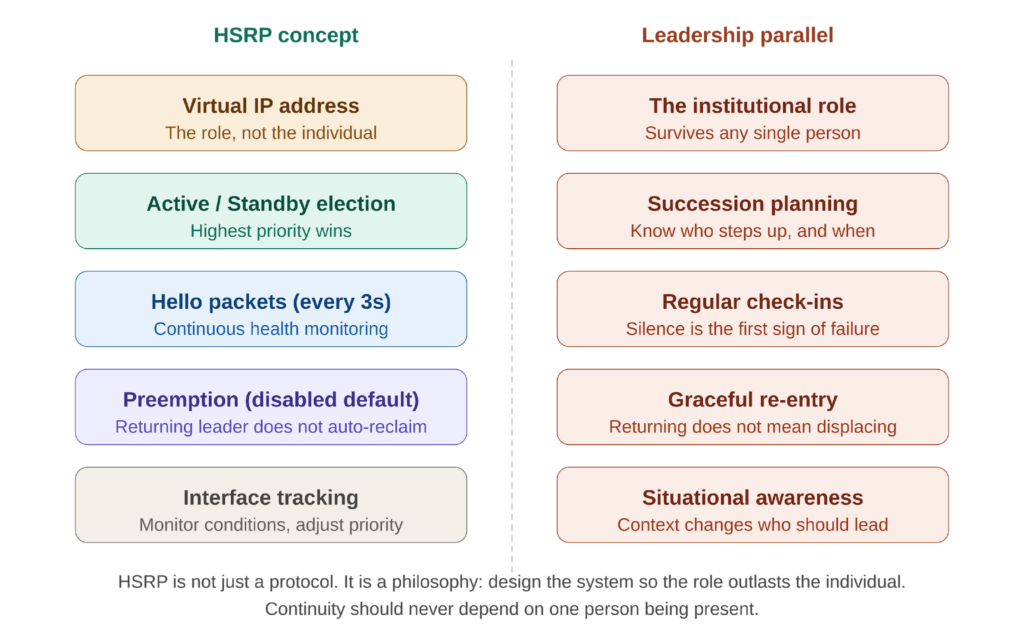
Figure 3: Five HSRP concepts and their direct parallels in organizational leadership.
The virtual IP is the institutional role. When you build an organization where critical functions are attached to roles rather than people, you create resilience. The role has documented responsibilities, defined interfaces, and clear expectations. When the person filling it leaves, the role remains — and someone else can step into it without the rest of the organization having to reconfigure.
The active/standby model is succession planning. Every critical function should have a clearly identified backup — someone who knows the role, understands the context, and is ready to step in. Not as a hypothetical exercise, but as an operational reality. The standby is not idle. The standby is monitoring, learning, maintaining readiness.
Hello packets are regular check-ins. In HSRP, the first sign of failure is not a crash — it is silence. Three missed hello packets, and the system begins failover. In organizations, the same principle applies. When communication stops — when a leader goes quiet, when updates cease, when the regular cadence of contact breaks — that is the signal that something may be wrong. The check-in is not bureaucracy. It is the heartbeat of operational awareness.
Preemption is the politics of return. When a leader steps away — for leave, for illness, for a temporary assignment — and someone else steps into the role and performs well, what happens when the original leader returns? HSRP’s default answer is instructive: the system does not automatically restore the original. Stability matters more than rank. The returning leader joins as standby, and the transition happens deliberately, not disruptively.
Interface tracking is situational awareness. A router may be running, but if its upstream link is down, it should not be active — because it cannot actually fulfill the role. Similarly, a leader may be present but if the conditions around them have changed — if their key relationships have shifted, if their mandate has evolved, if the context demands skills they do not have — the system should be able to adjust who leads, dynamically, without waiting for a complete failure.
Designing for Continuity
The deepest lesson of HSRP is not about routers. It is about the difference between systems that depend on individuals and systems that depend on roles.
In too many organizations, critical knowledge lives inside one person’s head. Critical relationships are held by one individual. Critical decisions route through one desk. When that person takes a vacation, things slow down. When they leave the company, things break. This is an organization running without HSRP — a single gateway, no standby, no failover, no virtual abstraction of the role from the person.
Designing for continuity means asking: if this person were unavailable tomorrow, would the function they serve continue? Is there a standby? Does the standby know the role? Are there hello packets — regular communication that keeps the standby informed and ready? Is the transition plan documented, or is it a hope?
HSRP was built because engineers understood that hardware fails. The best leaders understand the same thing about people — not that people are unreliable, but that depending on any single individual for a critical function is a design flaw, not a compliment. The compliment is building the system well enough that the role outlasts any one person’s tenure in it.
The best redundancy is invisible. The hosts never know the failover happened. That is not a limitation of the protocol — it is the entire point.
Cisco HSRP Command Cheatsheet
Quick reference for configuring, verifying, and troubleshooting HSRP on Cisco IOS devices.
Basic HSRP configuration
interface GigabitEthernet0/1

 ip address 10.1.1.2 255.255.255.0

 standby 1 ip 10.1.1.1
Enables HSRP group 1 on the interface with virtual IP 10.1.1.1. The group number (1) must match on all participating routers.
Set HSRP version
standby version 2
Switches to HSRPv2. Supports up to 4,096 groups, millisecond timers, and multicast 224.0.0.102. Must match on all routers in the group. Not compatible with v1.
Priority configuration
standby 1 priority 110
Sets HSRP priority to 110 (default is 100). The router with the highest priority becomes the active router. Range: 1–255.
Enable preemption
standby 1 preempt
Allows this router to take over as active if its priority is higher than the current active router. Disabled by default.
Preemption with delay
standby 1 preempt delay minimum 180
Delays preemption for 180 seconds after the router comes online. Allows routing tables to converge before taking the active role. Cisco recommends setting this to half the router boot time.
Configure timers
standby 1 timers 1 4
Sets hello timer to 1 second and hold timer to 4 seconds (defaults: 3s hello, 10s hold). Faster timers = faster failover but more overhead. Must match on all routers.
Millisecond timers (v2 only)
standby 1 timers msec 200 msec 750
Sets hello to 200ms and hold to 750ms for sub-second failover. Requires HSRPv2.
Interface tracking
standby 1 track GigabitEthernet0/0 20
Monitors GigabitEthernet0/0. If it goes down, HSRP priority is decremented by 20. Decrements are cumulative across tracked interfaces. Default decrement is 10 if not specified.
Object tracking (modern syntax)
track 100 interface GigabitEthernet0/0 line-protocol
!
interface GigabitEthernet0/1
standby 1 track 100 decrement 20
Creates a tracked object (100) and links it to the HSRP group. More flexible than legacy interface tracking — supports IP SLA and route tracking.
Object tracking with shutdown
standby 1 track 100 shutdown
Instead of decrementing priority, disables the HSRP group entirely when the tracked object goes down. Forces immediate failover.
MD5 authentication
standby 1 authentication md5 key-string MySecretKey
Adds MD5 authentication to HSRP messages. Prevents unauthorized routers from joining the HSRP group. All routers must use the same key.
Plain-text authentication (legacy)
standby 1 authentication MyPassword
Basic authentication. Sent in clear text — use MD5 instead in production environments.
HSRP group name
standby 1 name SITE-A-GW
Assigns a human-readable name to the HSRP group. Useful for identification in complex environments.
Use burned-in MAC address
standby use-bia
Uses the interface’s physical MAC instead of the HSRP virtual MAC. Required in some Token Ring or FDDI environments.
Verification and Troubleshooting
Show HSRP status (detailed)
show standby
Displays full HSRP state for all groups on all interfaces: active/standby router, virtual IP and MAC, priority, preemption status, timers, and tracking state.
Show HSRP status (summary)
show standby brief
One-line-per-group summary showing interface, group, priority, state (Active/Standby/Listen), active and standby router IPs, and virtual IP.
Show HSRP on a specific interface
show standby GigabitEthernet0/1
Limits output to a single interface. Useful on devices with many HSRP groups.
Debug HSRP events
debug standby events
Shows HSRP state transitions: elections, coup and resign messages, preemption events. Use during troubleshooting, not in production.
Debug HSRP errors
debug standby errors
Shows HSRP error conditions such as authentication mismatches or version conflicts.
Debug HSRP (terse mode)
debug standby terse
Reduced-verbosity debug output. Useful for monitoring without overwhelming the console.
Disable debugging
undebug all
Turns off all debug output. Always run this after troubleshooting.
Leave a Reply