What Network Architecture Teaches Us About Building Organizations
A network diagram is not just a technical drawing.
It is a philosophy — a set of decisions about how things relate, how they scale,
and what happens when something breaks!
Some of my favorite screenshots — the ones I keep coming back to, the ones I actually get a little excited showing people — are network diagrams. Not dashboards. Not analytics. Network design drawings.
That might sound like the most niche thing in the world. But what a network diagram really is, underneath all the boxes and lines and acronyms, is a philosophy. A set of decisions about how things relate to each other, how they scale, what happens when something breaks, and how you build something meant to outlast any single component within it.
That is not just a technology problem. That is a leadership problem. And it is the subject of this post.
Organic Growth — The Enemy of Scale
Everyone starts small. You get your first IT job, or you take over a small office. The network is simple: an internet connection, a firewall, a router, a switch, a handful of PCs, and a wireless access point. Done.
Then the company grows. You add more computers. An IP phone system. Printers. Someone wants a display screen in the conference room. You move to a bigger office — two floors now. And suddenly that one switch you started with is the center of a web that you did not design so much as accumulate.
This is what network engineers call organic growth. And it is, almost universally, a disaster waiting to happen. Not because any individual decision was wrong. But because no one ever stepped back and asked: what is this supposed to look like when it is bigger? What happens when that one switch fails? What if the connection between the two floors goes down? What if we need to add an entirely new building?
When you build organically, you build fragility into the foundation. And the cost of fragility is not paid on day one — it is paid on the day something breaks, at the worst possible moment, when the stakes are highest.
In leadership, we call this reactive management. In network engineering, we call it a mess. The solution to both is the same: stop thinking about your system as a collection of connected things, and start thinking about it as an architecture.
The Three Layers
The model that has been the standard for enterprise network design for decades is called the Hierarchical Network Model. It gives us three foundational layers, each with a distinct responsibility.
The Access Layer is where your users live. Computers, phones, printers, wireless access points — everything a human being directly touches plugs in at the access layer. It is the edge of the network, closest to the people. Because of that, it is where you have the most devices, the most variety, and the most unpredictability.
The Distribution Layer is the intelligent middle. It enforces policies. It handles routing decisions between different parts of the network. It aggregates traffic from all those access switches and decides what goes where. If you think of the network as a building, the distribution layer is the structural engineering — the load-bearing decisions about how forces are directed.
The Core Layer has one job: move traffic as fast as possible. The core does not filter. It does not inspect. It does not make policy decisions. It connects everything at speed. In a well-designed network, the core is the simplest, most reliable, most protected part of the system — precisely because its scope is narrow.
The hierarchy creates predictability. When something breaks at the access layer, you know the blast radius. When a policy needs to change, you know it happens at distribution. When you need to add capacity, you know the core can absorb it. Every layer has a role, and every role has a boundary.
The Leadership Parallel
The parallel to organizational design is immediate, and it is not a metaphor — it is a structural principle that applies to any system you are responsible for building.
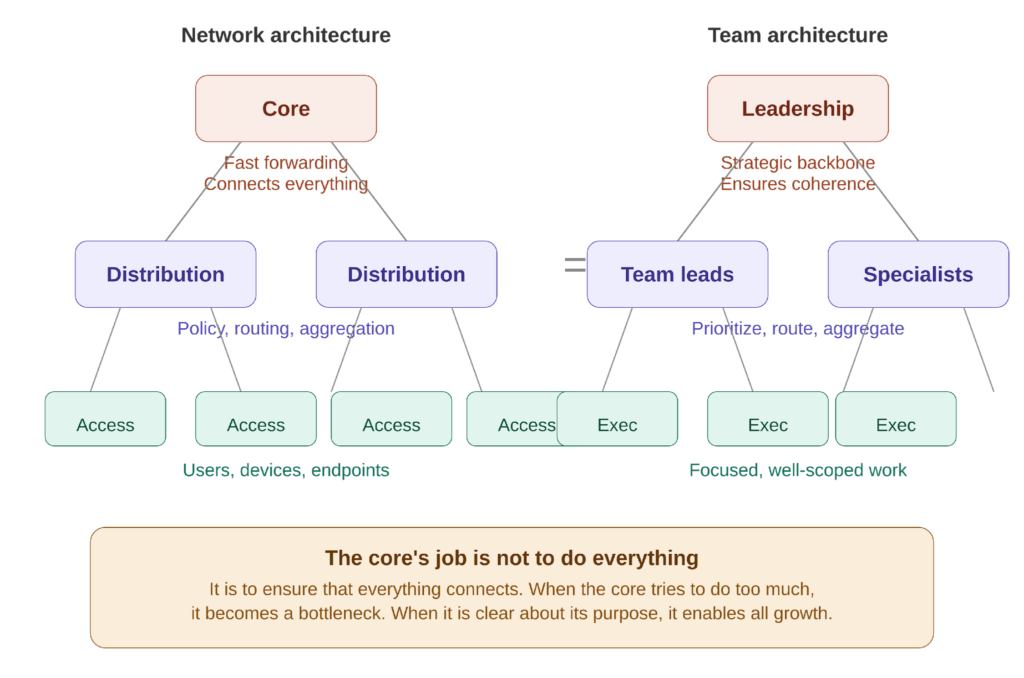
Figure 1: The hierarchical network model mapped to team architecture — same structure, same principles.
Think about the organizations you have been part of. How many of them were built using the organic growth model? Someone needed a thing done, so a person was hired. That person was good, so they took on more. Something adjacent came up and they absorbed it. No one ever asked: what is this team’s architecture? What is the access layer? What is the distribution layer? What is the core?
Then one day that person leaves — the one who was doing four different jobs because they had accumulated them organically — and suddenly you have no idea what they were doing, or how it connected to anything else. That is a network without a hierarchical model. That is organic growth coming due.
A hierarchical team design has a clear access layer — the people closest to the work, doing focused, well-scoped execution. A distribution layer — team leads and specialists who aggregate information, apply policy, and make routing decisions about priorities and resources. And a core — the leadership function, whose job is not to do everything but to ensure that everything connects, that the organization as a whole can move fast and stay coherent.
The Modular Building Block Architecture
Three layers is enough to understand a single building. But the real world has multiple buildings, multiple sites, servers, data centers, internet connections, and WAN links to remote offices. This is where the model evolves into something truly elegant.
Instead of thinking about core, distribution, and access as layers in a diagram, start thinking about them as blocks — self-contained modules that you can deploy anywhere and plug into your core.
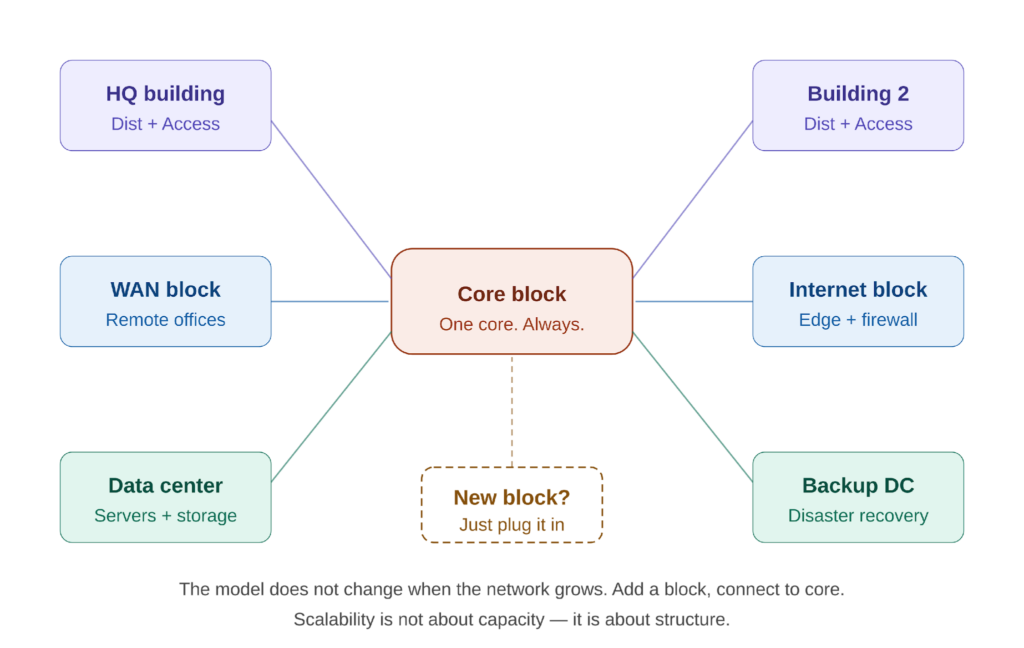
Figure 2: The modular architecture — one core, multiple pluggable blocks. Growth does not require redesign.
One core. Always one core. The core is the hub and everything connects through it. Then you have distribution blocks: one for headquarters, another for Building Two, another for Building Three. Each is its own module with its own access layer, all connecting back to the single core.
Then you add specialized blocks for specialized needs. A WAN block connecting remote offices. An Internet block with edge routers and firewalls. A data center block. A backup data center. Each a module. Each plugged into the core.
The genius is that the model does not change when the network grows. You do not redesign the architecture when you add a new site. You do not restructure the core when you bring a new data center online. You add a block, connect it to the core, and the system absorbs it.
That is what real scalability looks like. Not the ability to handle more load today — but the ability to grow tomorrow without breaking what you built yesterday.
When you need to grow your organization, the same principle applies. You do not restructure the core. You add a block — a new team, a new function. Define its role clearly. Connect it to the core. Let the model absorb the growth.
The Frontier: Fabric and Overlay
The three-tier model has limits, especially in the data center. Applications need to talk to each other constantly, and many of those conversations require layer-two connectivity — the same subnet, the same broadcast domain — even when they are physically on different switches. And layer two does not scale well. Spanning tree, the protocol that prevents loops, blocks redundant ports. You pay for links you cannot fully use. When it fails, the consequences are immediate.
The industry evolved toward a leaf-spine architecture. Spine switches at the top. Leaf switches below. Every leaf connects to every spine. No leaf connects to another leaf. Every connection is layer three — routed, not switched. No spanning tree anywhere.
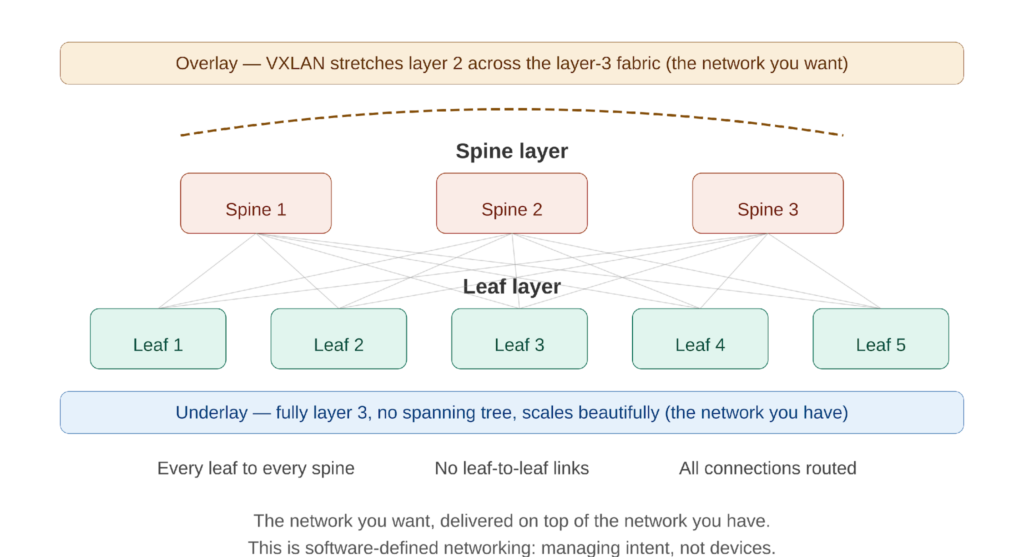
Figure 3: Leaf-spine fabric — a fully routed underlay with a VXLAN overlay stretching layer 2 where needed.
That is your underlay — the network you have. Fully layer three, scales beautifully. But your applications still need layer two. So you build an overlay using VXLAN that stretches layer-two connectivity across the layer-three underlay. The hosts at either end think they are on the same network segment. Underneath, packets are routed across a highly scalable fabric.
The network you want, delivered on top of the network you have.
This is software-defined networking at its most concrete: moving from managing individual devices to managing intent. You define the outcome you want, and the system delivers it across whatever physical infrastructure exists. The concept extends well beyond the data center — entire campus architectures are now built on this principle, fabric-based and controller-managed.
The Architect’s Mindset
The hierarchical network model teaches three lessons that apply far beyond networking.
Organic growth is not a strategy. It is the absence of a strategy, and it accumulates debt that someone will eventually have to pay. Every team, every system, every organization benefits from the question: what is the architecture here? What are the layers? What connects to what, and why?
Scalability is not about capacity. It is about structure. A well-architected network does not scale because it has more bandwidth. It scales because adding a new block does not require redesigning the core. The same is true of teams: the organizations that grow well are the ones where adding a new function does not break existing ones.
The core must be protected. The core’s job is not to do everything — it is to ensure that everything connects. When the core tries to do too much, it becomes a bottleneck. When the core is clear about its purpose, it becomes the thing that makes all other growth possible.
In your organization, in your team, in your career — what is your core? What is the function that everything else needs to connect through? And are you protecting it, or are you letting it accumulate responsibilities it was never designed to carry?
Draw your own hierarchical model. Not for a network, but for your team or organization. Label the blocks. Define what each one does, and what it does not do. Identify where the connections are redundant and where a single failure would take down an entire section. That diagram will tell you more than any org chart ever could.
Leave a Reply