When Software Redefines the Network’s Boundaries
The Wide Area Network has been the backbone of enterprise connectivity for decades.
But as our demands have grown, so have its costs and complexity.
Software-Defined WAN is the architectural answer.
If you have ever managed a Wide Area Network, you know the feeling. Multiple service providers. Redundant circuits that may or may not justify their cost. Routing adjacencies shared with carriers. Configuration policies deployed across dozens — sometimes thousands — of devices. And underneath it all, the quiet anxiety that one provider outage could sever the connections your business depends on.
The traditional WAN was built for reliability, and it delivered. But it was never built for agility, and that distinction matters more today than it ever has.
The Problem with Traditional WANs
The goal of any WAN is straightforward: connect all of your business locations to one another. Headquarters, branch offices, data centers, remote and home offices — all linked through a network that ideally provides redundancy and performance.
In practice, this means engaging at least one WAN service provider, and usually two for redundancy. Each location connects through whatever media is available — metro Ethernet, fiber, cellular (4G or 5G), legacy T1/E1 lines, or VPN tunnels. The reality is that some locations get the best options, and others get what is available. There is rarely uniformity across the entire footprint.
Then add the cloud. Every one of those business locations now needs connectivity not just to each other, but to cloud services — sometimes through the internet, sometimes through provider-managed paths. The topology becomes layered, and the complexity compounds.
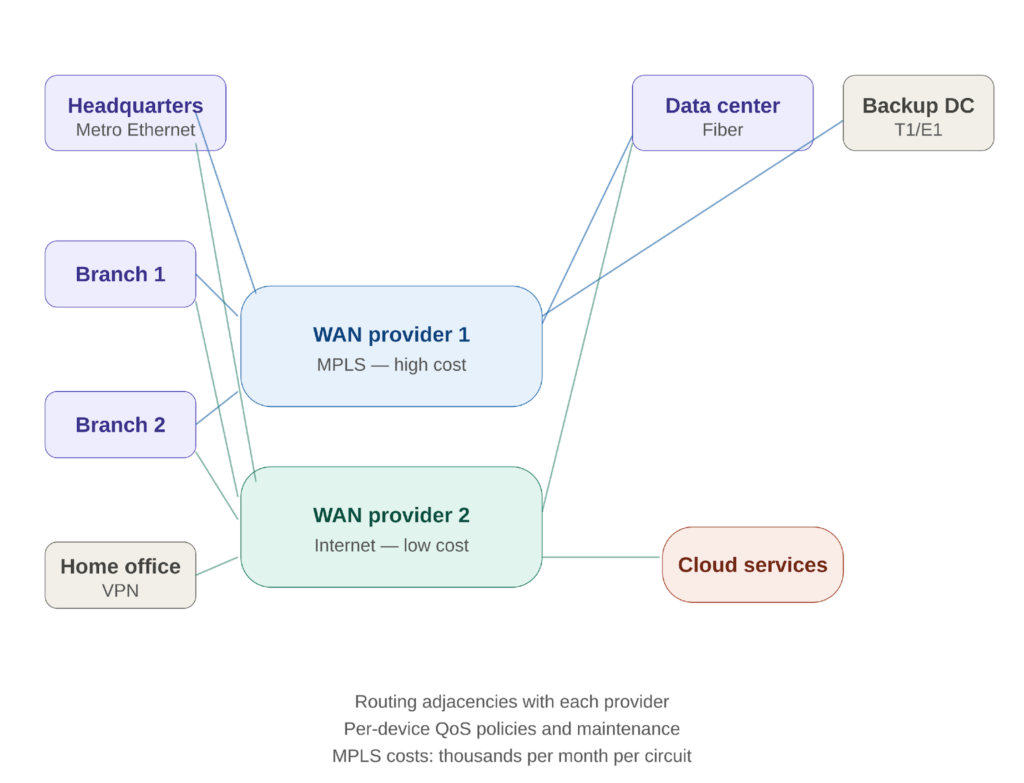
Figure 1: Traditional WAN complexity — dual providers, multiple site types, various media, and cloud integration.
On top of all of this sits configuration: quality of service policies, routing protocols, route sharing with service providers, and the ongoing maintenance of all of it. And maintenance, as any network engineer will tell you, is often harder than the initial deployment.
The cost dimension makes this worse. MPLS circuits — the gold standard for reliability — can run thousands of dollars per month depending on location and bandwidth. Meanwhile, commodity internet circuits offer dramatically more bandwidth at a fraction of the cost. But can you send your voice traffic across the internet and expect acceptable quality? For many organizations, the answer has been no, and so MPLS persists — expensive, reliable, and increasingly difficult to justify as the sole approach.
The design principles of traditional WANs — redundancy, reliability, deterministic routing — remain sound. But the cost and complexity of implementing them through legacy methods has become untenable for modern networks.
The Software-Defined Shift
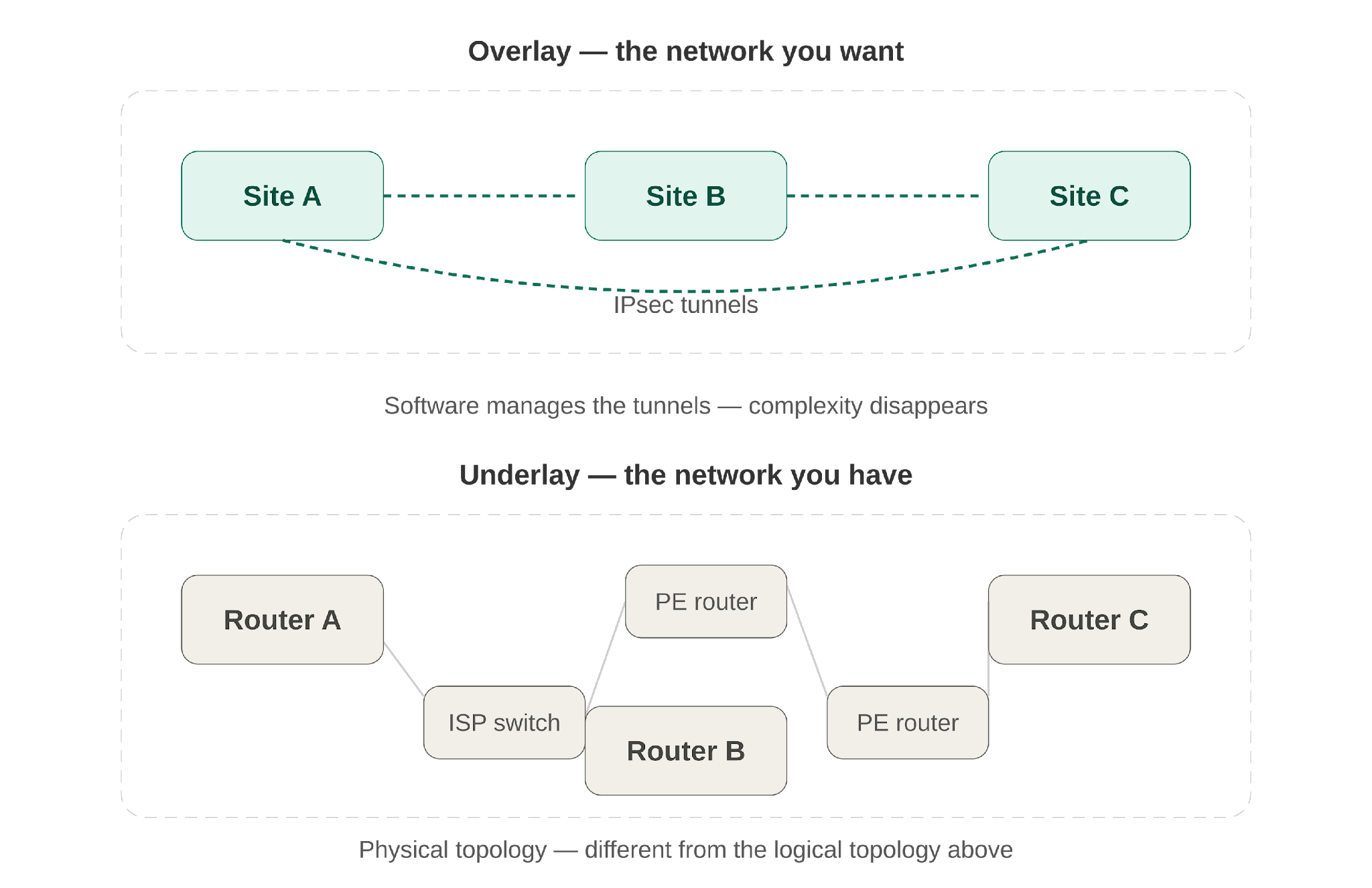
Software-Defined Networking introduces a foundational concept that changes the equation: the separation of the network into an underlay and an overlay.
The underlay is the physical network — the routers, switches, and circuits that exist in the real world. The overlay is a logical topology constructed on top of it. Think of it this way: the overlay is the network you want, drawn on paper exactly as you would design it. The underlay is the network you have. The purpose of SDN is to make the logical network you want operate seamlessly across the physical network you have.
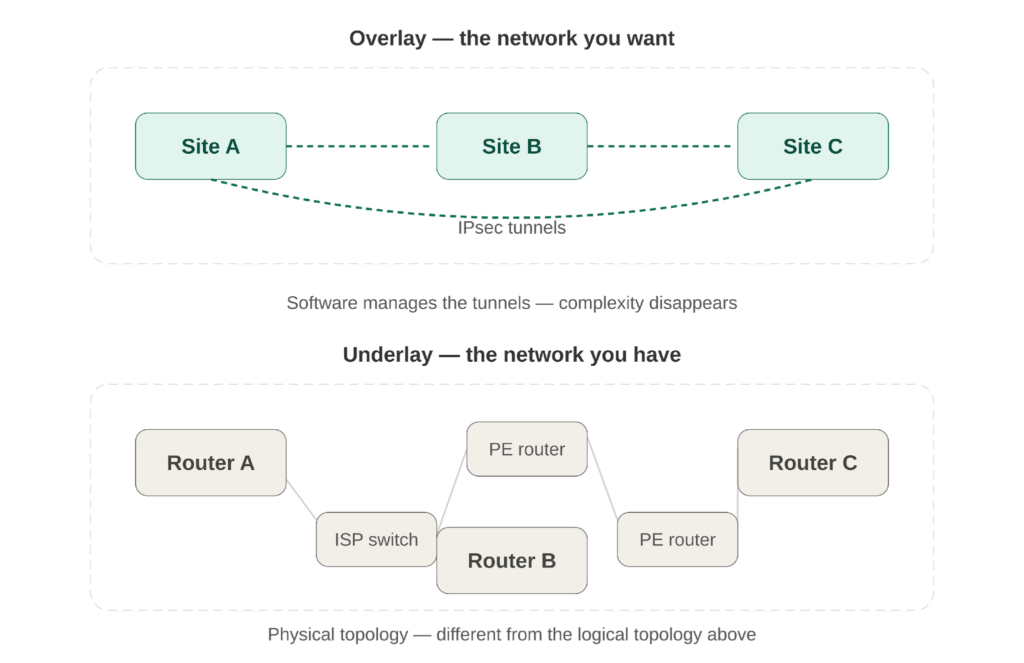
Figure 2: Underlay vs. overlay — the physical network below, the logical tunnel topology above.
The mechanism that makes this possible is the tunnel. Tunnels are, the Swiss army knife of networking — capable of creating virtually any topology across any underlying infrastructure. The historical problem with tunnels was not capability but complexity: manually provisioning, configuring, and maintaining them across a large environment was operationally painful.
This is where the “software-defined” part earns its name. If software manages the tunnels — their creation, their policies, their failover behavior — then the complexity of manual tunnel management disappears. What remains is the ability to define the network you want and let automation deliver it.
SD-WAN Architecture: The Four Planes
In a Cisco SD-WAN environment (originally built on the Viptela platform Cisco acquired), the architecture is organized into four components, each representing a distinct operational plane.
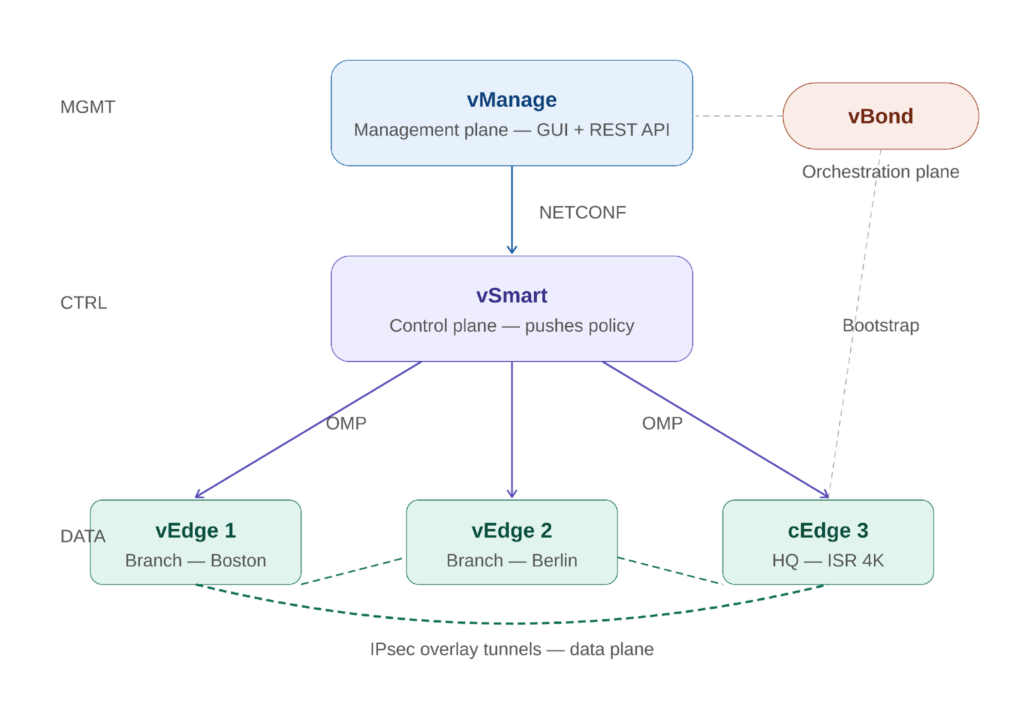
Figure 3: The four planes — vManage (management), vSmart (control), vEdge/cEdge (data), vBond (orchestration).
The Management Plane — vManage. This is the single pane of glass for the entire SD-WAN domain. Administrators log into a web-based interface to define configurations, monitor network health, and manage policies. The key insight here is that individual device configuration becomes unnecessary. Instead, you create templates — standardized configurations that can be applied to any number of edge devices simultaneously. When a policy changes, it propagates across the entire network from this single point. At scale, this is transformative.
The Control Plane — vSmart. The vSmart controller receives the policies defined in vManage and pushes them down to the edge devices. It is responsible for the intelligence of the network — determining how policies translate into forwarding decisions across the overlay.
The Data Plane — vEdge (and cEdge). These are the edge routers deployed at each location. They can be physical appliances or virtual instances running in cloud infrastructure. The vEdge devices form IPsec tunnels between one another, creating the overlay network. Cisco has also introduced the cEdge model — Integrated Services Routers (ISRs) running Viptela code instead of traditional IOS — to support locations that require legacy connectivity like voice lines or serial connections.
The Orchestration Plane — vBond. The orchestrator sits out of band and handles the initial bootstrapping of the network. When a new vEdge comes online, it contacts the vBond to discover where its vSmart controllers are. It also assists with NAT traversal and the coordination that glues the other components together.
This four-plane architecture reflects a broader principle in systems design: separate the concerns. Management, control, data forwarding, and orchestration each have distinct responsibilities, and keeping them distinct makes the system more maintainable and more resilient.
Topology and Traffic Intelligence
One of the most compelling capabilities of SD-WAN is the ability to define topology and traffic policy on a per-application basis.
Figure 4: Four topology options — hub and spoke, full mesh, partial mesh, and point-to-point.
For topology, the options include full mesh (every site connected to every other site), hub and spoke (all sites connecting through a central location), partial mesh (selective direct connections between specific sites), and point-to-point links between individual locations. The choice depends on the organization’s needs, and importantly, these can coexist within the same network.
For traffic management across multiple WAN circuits, SD-WAN provides four primary approaches:
Active-Active distributes traffic across both circuits equally — straightforward load balancing when both paths can reach the destination.
Active-Active Weighted adjusts the distribution ratio based on circuit capacity. If one link is 100 Mbps and the other is 50 Mbps, traffic is distributed in a 2:1 ratio rather than equally.
Active-Standby with Application Pinning assigns specific application traffic to a preferred circuit. Voice traffic, for example, might always use the more reliable MPLS link, falling back to the internet circuit only if MPLS fails.
Application-Aware SLA takes this further by monitoring real-time metrics — jitter, latency, packet loss — on each circuit. If the preferred path degrades beyond a defined threshold, traffic is automatically rerouted to the healthier circuit. This is the capability that fundamentally changes the cost equation: if you can dynamically shift voice traffic between two internet circuits based on real-time quality, you may no longer need MPLS at all.
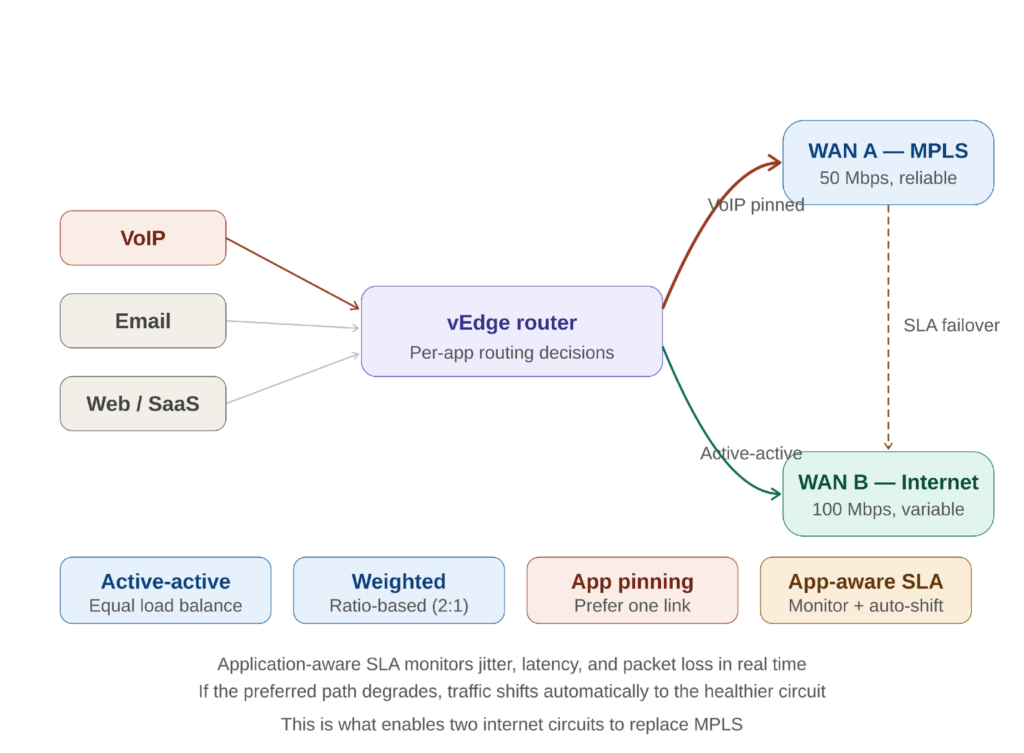
Figure 5: VoIP pinned to MPLS, email/web load-balanced, with automatic SLA failover.
Applications are identified either through Deep Packet Inspection (a licensed feature that examines packet contents directly) or through a six-tuple lookup — source and destination IP, source and destination port, DSCP marking, and IP protocol number. DPI is more accurate, but the six-tuple approach provides a capable alternative.
Programmability: The API Layer
Beneath the vManage GUI lies a REST API. The graphical interface that administrators interact with is itself an application making REST API calls to the vManage appliance. This means that anything accomplished through the GUI can also be accomplished programmatically — through custom scripts, automation pipelines, or third-party integrations.
The internal communication between components uses different protocols: vManage communicates with vSmart controllers via NETCONF (XML messages over SSH), while vSmart pushes policies to vEdge devices using the Overlay Management Protocol (OMP). The REST API layer, however, is what opens the architecture to external programmability and integration with broader IT automation frameworks.
This is worth pausing on. The fact that the management interface is itself an API consumer means the network is not just configurable — it is integrable. It can participate in workflows that span beyond networking into provisioning, security, compliance, and operational orchestration.
The Architectural Lesson
SD-WAN is, at its core, an argument for abstraction. It takes the messy reality of physical circuits, diverse providers, and heterogeneous media types, and it places a clean logical layer on top. It moves intelligence to the edges and policy to a central controller. It replaces per-device configuration with template-driven management. And it makes the network responsive to real-time conditions rather than static rules.
For those of us who think about infrastructure as a leadership discipline — who believe that the systems we build reflect the organizational principles we hold — SD-WAN is a case study in what happens when you stop managing complexity and start designing it away.
The traditional WAN was not wrong. It was a product of its constraints. SD-WAN does not reject those constraints; it reframes them. The circuits are still there. The providers are still there. The physics of latency and jitter have not changed. What has changed is the layer of intelligence that sits between the business and the infrastructure — and that layer makes all the difference.
Hessam Zahedi – IT leadership, network architecture, and systems thinking at hessamzahedi.com
Leave a Reply