Being born in middle east, towards the end of the war, growing up in post-war time, meant growing up in a society where politics, ideology, and geopolitics were not abstract concepts but visible forces shaping daily life. Debating and listening to many talks from political activists and theorists about what the government system should be, and seeing how different ideologies perform in the real world, naturally pushed me toward a deep interest in how decisions, strategies, and events can shape the future.
Having lived in both Iran and the United States, and worked in many other places, for me meant learning early how macro‑level decisions, sanctions, censorship, geopolitical tensions, supply chain, and most importantly people and culture translate directly into the fabric of everyday life, businesses, prosperity, and human freedom and flourishment. I learned how open debate, being open-minded, support of law, and a vibrant technology ecosystem can help flows of capital, ideas, and data.
Experiencing these contrasts first‑hand – from internet shutdowns and restrictions to open access and rapid digital innovation – made me acutely aware of how governance models, civil liberties, and technological infrastructure shape people’s opportunities, security, and sense of agency. This dual vantage point anchors my interest in democracy, diversity of ideas, freedom, and technology, not in theory, but in the lived reality of how different systems enable or constrain human potential.
Over the years, I have witnessed and experienced multiple political and economic shifts, pandemics, and advanced geopolitical tensions on ordinary people and on businesses. This experience made me interested in change management, the power of technological disruption, and analyzing risks and opportunities for organizations, markets, and citizens.
The business world increasingly operates in what the World Economic Forum often describes as a landscape of overlapping crises, where geopolitical fragmentation, technological acceleration, and social polarization interact in complex ways. In such an environment, leaders must care about democracy, rule of law, and open institutions not only as values, but as key enablers of stable investment climates, innovation, and long‑term value creation. At some point in this journey, I discovered that there is an entire field dedicated to thinking systematically about these dynamics over time: futures studies.
Futures studies (often called futures research, futurology or strategic foresight) is the systematic, interdisciplinary and holistic study of possible, probable and preferable futures, focusing on social and technological advancement and other environmental trends, with the aim of understanding how people may live and work in the future. Instead of trying to predict a single outcome, it explores alternative futures – including “wild cards” and low‑probability, high‑impact events – and examines the worldviews, values, and narratives that shape our collective choices.
What attracted me most is how futures studies connects technology, governance, and economics into one holistic lens. In practice, the field often uses the STEEP framework (Social, Technological, Economic, Environmental, and Political) to map how trends interact and to identify where early signals of change might emerge. This aligns closely with how forward‑looking organizations now think about risk: not as isolated technical or financial issues, but as interconnected patterns that require systems thinking and strategic foresight. The World Economic Forum, for example, highlights futures literacy, anticipation, and systems thinking as critical skills for dealing with global shocks and designing better post‑crisis futures.
My long‑standing interest in technology and strategy naturally found a home in this perspective. In the last decade, digital infrastructure, cybersecurity, and cloud technologies have become not just operational tools but foundational elements of how societies govern, deliver public services, and protect fundamental freedoms.
Digital transformation in governance is projected to unlock trillions of dollars in public value globally by increasing transparency, reducing corruption, and enabling more responsive, data‑driven decision‑making. There are various examples in digital‑first public services that illustrates how well‑designed technology can strengthen trust, accountability, and citizen participation when implemented with strong democratic safeguards.
See: https://www.weforum.org/publications/the-global-public-impact-of-govtech/
At the same time, there is growing awareness that technology can also amplify polarization, enable surveillance, and undermine trust if it is not anchored in democratic norms and robust institutions. Bringing AI into the picture, everything suddenly gets amplified. (Book recommendation: Nexus, A Brief History of Information Networks from the Stone Age to AI).
This tension – between technology as a tool for openness and technology as an instrument of control – is central to my curiosity about the future. It resonates with my own lived experience of how information, infrastructure, and power interact in societies undergoing rapid change.
Professionally, working at the intersection of IT infrastructure, cybersecurity, and organizational strategy has given me a concrete vantage point on these themes. Critical digital systems are now deeply entangled with macro‑risks: geopolitical conflicts, supply‑chain disruptions, regulatory changes, cyber warfare, and shifts in global norms around privacy and data protection.
Futures studies provide language and tools – scenario planning, horizon scanning, and strategic foresight – that help translate these uncertainties into more resilient architectures, more adaptive strategies, and more thoughtful risk management.
Bringing all of this together, my interest in technology is not purely academic. It is about how societies can harness digital innovation to expand participation, improve governance, and support human development, while remaining vigilant about new concentrations of power and new forms of systemic risk. Futures studies, as a discipline dedicated to the exploration of possible and preferable futures, offers a framework for connecting these concerns to the practical realities of business, policy, and everyday life, and that is precisely the space where I aim to think, work, and contribute.
Challenges.
https://publicdomainreview.org/collection/a-19th-century-vision-of-the-year-2000
Although we might not predict the future correctly, and many confident forecasts about technology, society and business have turned out to be dramatically wrong.
https://publicdomainreview.org/collection/a-19th-century-vision-of-the-year-2000
Future developments always rest on layers of assumptions about how things are interconnected, what actors’ objectives and interests are, and what the world is actually like. We also need diverse voices and perspectives, because only a plurality of experiences and disciplines can help us see the blind spots in our thinking and challenge the default narratives we carry about what is possible or desirable.
Future developments involve lots of assumptions about how things are interconnected, what the objectives and interests are, and what the world is actually like.
It is necessary to critically assess such future imagery and highlight the prevailing assumptions about the future. Same concepts are also applicable to businesses and business strategy, as demonstrated in the ‘Cone of Possibility’
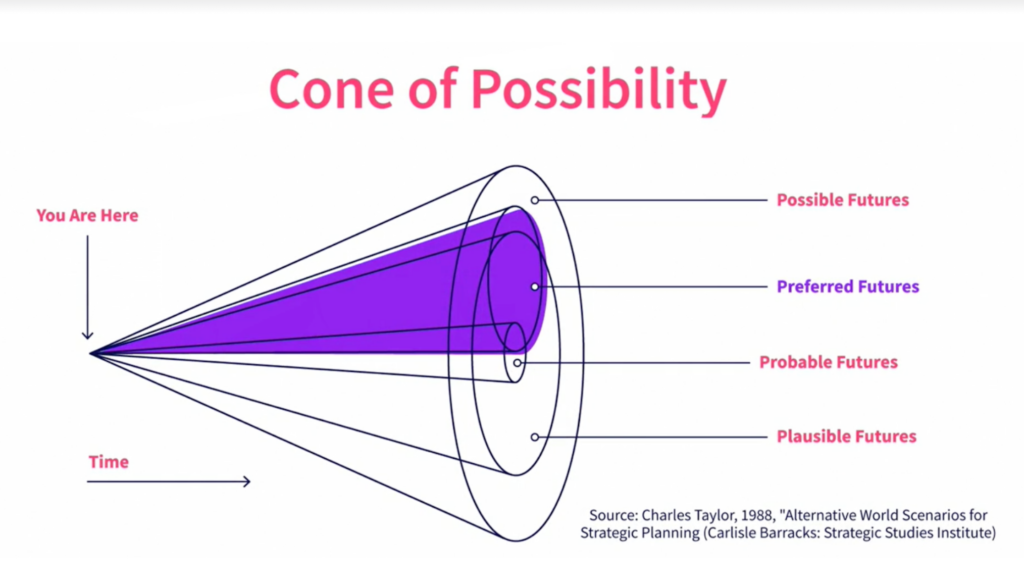
We can use certain skills nad tools to help make these ideas more concrete. Starting from the present moment (“you are here”), extends outward in the shape of a cone, representing a widening space of different futures. Within this cone, we usually distinguish four layers:
- Possible futures: everything we can imagine that does not clearly break the laws of nature.
- Plausible futures: futures that could realistically happen, given what we know today about trends, systems and constraints.
- Probable futures: futures that are likely to occur if current trends and power structures continue without major disruption.
- Preferred futures: futures we actually want to move toward, based on our values, aspirations and ethical choices.
Using the cone invites us to explore a range of plausible and probable futures, and then clarify which preferred futures we want to intentionally shape.
For me, as someone working in IT and technology leadership, this way of thinking is directly practical. Leading digital infrastructure, security, and operations in a volatile ever changing world means constantly scanning for signals of change, emerging technologies, and societal expectations. Futures studies help me frame these uncertainties, test strategies against multiple scenarios, and design systems that are more resilient, adaptable, and aligned with human and business values. They sharpen my ability to connect macro‑level risks and opportunities with day‑to‑day technical decisions, so that my work is not only about keeping systems running, but also about helping organizations navigate change and create better futures.