Why the Most Powerful Professionals Are Shaped Like the Letter M
On professional archetypes, the neuroscience of mastery,
and why quitting might be the smartest thing you ever do.
There is a question that sits underneath almost every career decision we make, and most of us never articulate it clearly: what shape should my professional knowledge take? Should I go deep in one thing and become indispensable? Should I spread wide and become adaptable? Or is there a third option — one that the modern world may actually reward more than either extreme?
This is a question about professional identity, but it is also a question about how the brain learns, what motivates us to persist, and why so many talented people abandon skills just when they are about to break through. The answer, I believe, lives in the shape of the letter M.
The World Has Changed. Your Shape Should Too.
The traditional model of professional development was built for what researchers call a kind learning environment — a world where the rules are clear, feedback is immediate, and repetition is rewarded. In that world, the specialist thrives. You learn one discipline deeply, you practice it for decades, and your expertise compounds. The doctor who performs the same surgery a thousand times. The engineer who masters a single programming language. The accountant who knows tax law cold.
But the modern professional world is not a kind learning environment. It is what researchers call a wicked learning environment — one where the rules constantly change, feedback is delayed or ambiguous, and the patterns that worked yesterday may not work tomorrow. Technology shifts underneath us. Industries converge. The boundaries between disciplines blur. In this environment, the specialist who knows only one thing is not indispensable — they are fragile.
This does not mean depth is worthless. It means depth alone is insufficient. We need a new shape.
Three Professional Archetypes
Imagine your professional knowledge as a shape drawn on paper. The vertical axis represents depth — how far you have gone into a single domain. The horizontal axis represents breadth — how many domains you have touched.
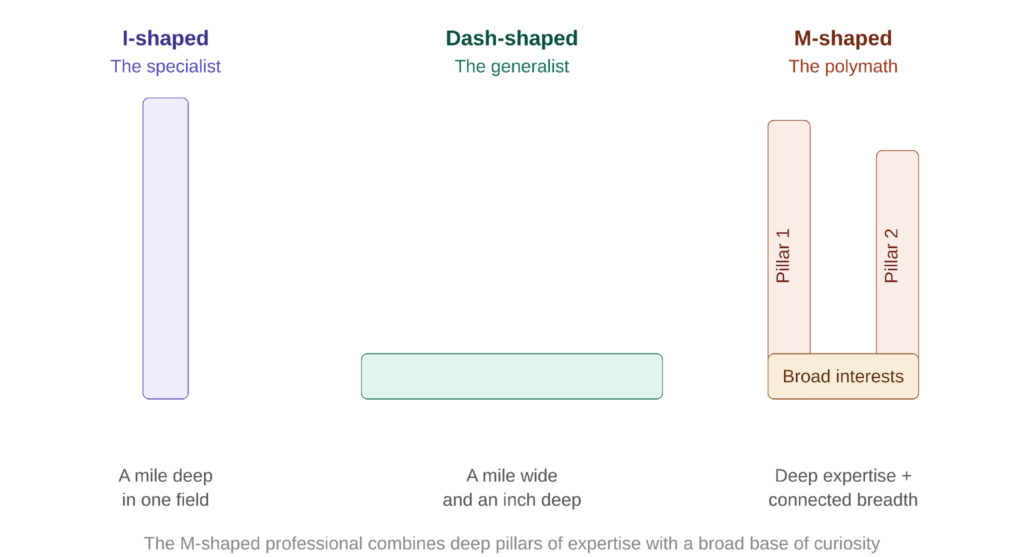
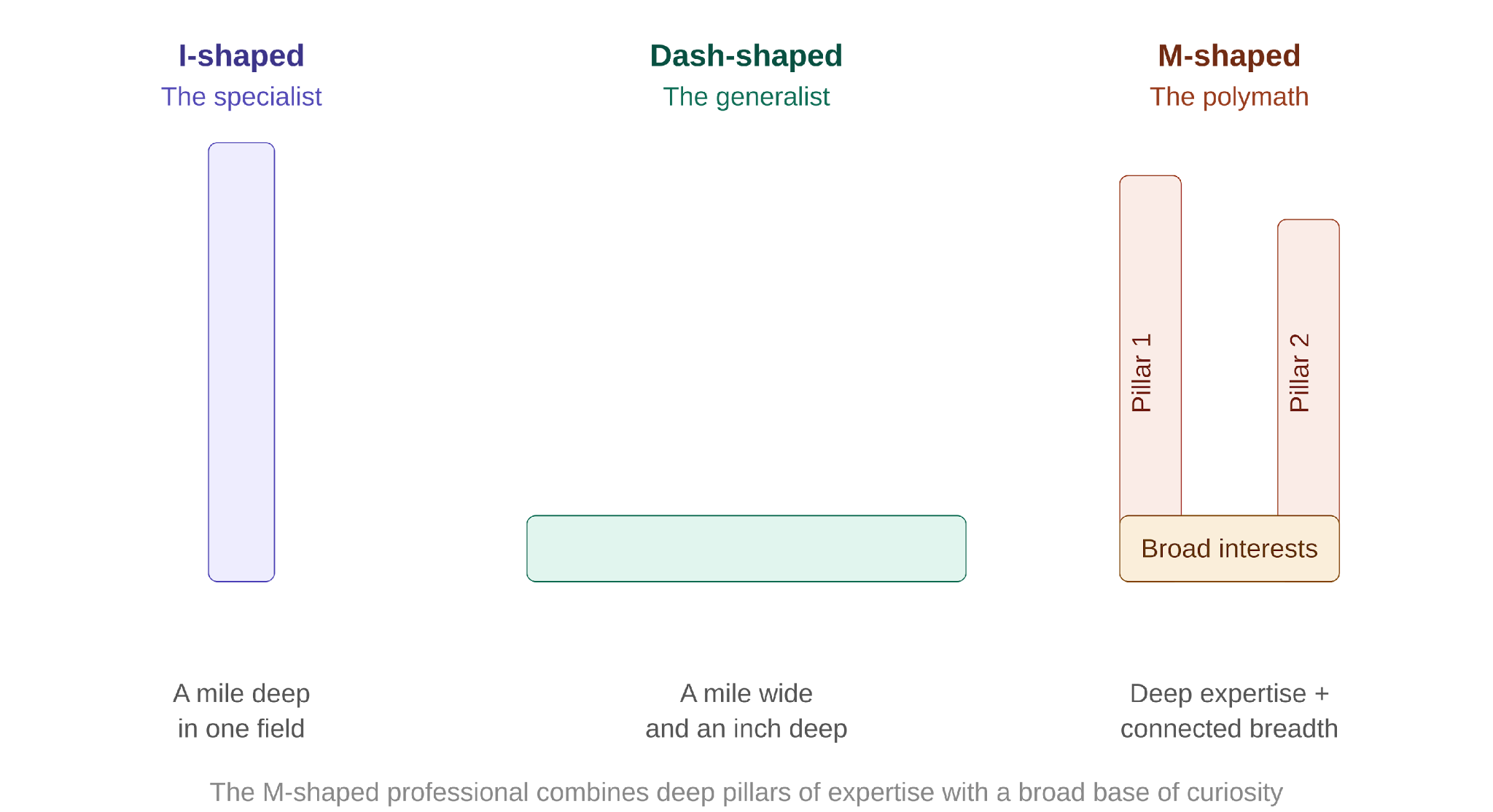
Figure 1: The I-shaped specialist, the dash-shaped generalist, and the M-shaped polymath (looked better in form U so I went with that but imagine it’s M shaped! LOL).
The I-shaped professional is the classic specialist: a mile deep in one narrow field. In a stable industry with clear rules, this person is invaluable. But if their field shifts — if the technology changes, if the market moves, if their one skill becomes automated — they have no adjacent ground to stand on.
The dash-shaped professional is the opposite: a mile wide and an inch deep. They know a little about everything and can hold a conversation on any topic. But they lack the credibility that comes from genuine mastery. They are interesting at dinner parties and overlooked for promotions.
The M-shaped professional combines the strengths of both. They have deep expertise in multiple areas — the vertical pillars of the M — connected by a broad base of curiosity and cross-domain interests. A data scientist who also has deep knowledge of storytelling, connected by interests in psychology, history, and design. This combination allows them to do something neither the specialist nor the generalist can: they can translate complex data into compelling narratives for executives. That is a rare and valuable skill, and it exists precisely because the pillars are connected by the base.
The Polymath’s Secret Weapon: Far Transfer
The M-shaped professional possesses a cognitive tool that specialists rarely develop: far transfer. This is the ability to see an underlying structure in one field and apply it to a completely different one.
Specialists use near transfer — applying a skill to a closely related problem. A Java developer learning Kotlin. A tax accountant expanding into audit. The domains are adjacent, and the patterns carry over naturally.
Far transfer is different. It is a musician using concepts of harmony to structure software architecture. It is an engineer applying the branching patterns of a root system to organize a company database. It is a philosopher applying Heidegger’s concept of readiness-to-hand to explain why good IT infrastructure should be invisible. The domains are distant, and the pattern recognition required to bridge them is precisely what makes the M-shaped professional so valuable.
Far transfer does not happen by accident. It requires genuine depth in multiple domains — not surface familiarity, but the kind of understanding that lets you see the structural principles underneath the surface details. You cannot apply musical harmony to software design if your understanding of harmony is limited to knowing that chords exist.
Building the M: Serial Mastery
How do you actually build an M-shaped professional life? The answer is not to pursue everything at once. It is to build pillars sequentially — a strategy I call serial mastery.
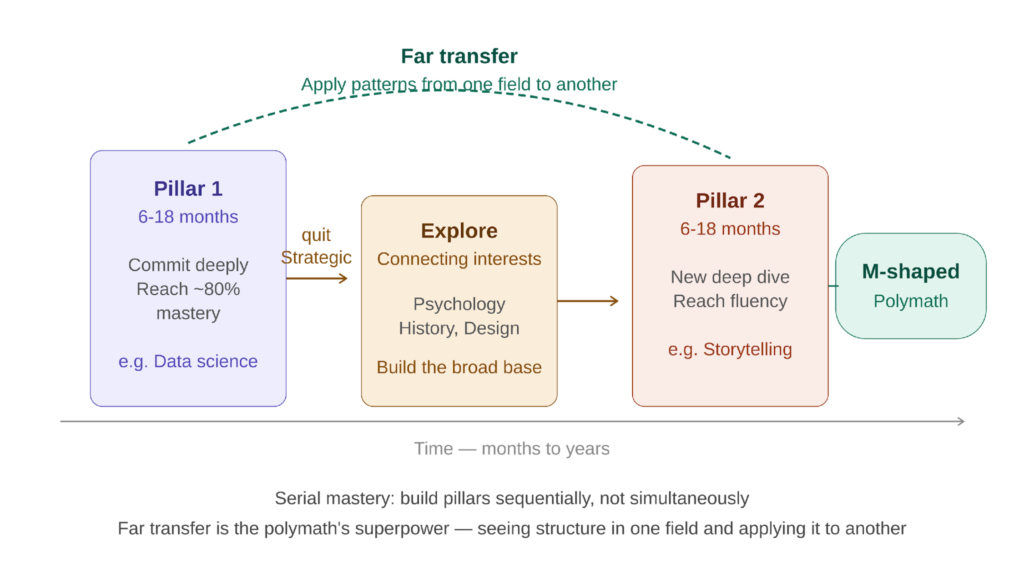
Figure 2: Building pillars sequentially through serial mastery, connected by far transfer.
The process works like this. You commit to one discipline — your first pillar — for a sustained period, typically six to eighteen months. You push until you reach roughly 80% mastery: not world-class expertise, but genuine fluency. The kind of understanding where you can see the principles underneath the techniques.
Then you make a conscious decision to move on. This is strategic quitting — fundamentally different from a dabbler abandoning something out of frustration. You are not giving up. You are graduating. You have extracted the structural knowledge from this domain, and now you carry it forward as you build the next pillar.
Between pillars, you explore. You follow curiosity across adjacent fields. You read broadly. You have conversations with people in disciplines unlike your own. This exploration builds the horizontal base of the M — the connecting tissue that makes far transfer possible.
Then you dive again. A new pillar. A new period of sustained depth. And as you build it, something remarkable happens: insights from your first pillar start illuminating the second. Patterns you learned in data science show up in storytelling. Principles from network architecture appear in organizational design. The M begins to form, and its shape becomes your competitive advantage.
Two supporting strategies make this sustainable. The first is the strategic day job — a stable, manageable role that provides financial security and leaves surplus mental energy for exploration. Einstein worked as a patent clerk while developing special relativity. The day job is not a failure; it is infrastructure. The second is an external system for ideas — a method like the Zettelkasten (used by sociologist Niklas Luhmann) for capturing, linking, and retrieving insights across domains. Working memory is too limited to hold the web of connections that polymathic thinking requires. You need a system outside your head.
The Neuroscience of the Plateau
There is a reason most people never build even one genuine pillar of mastery, let alone two or three. The reason is neurochemical, and understanding it changes how you approach skill development.
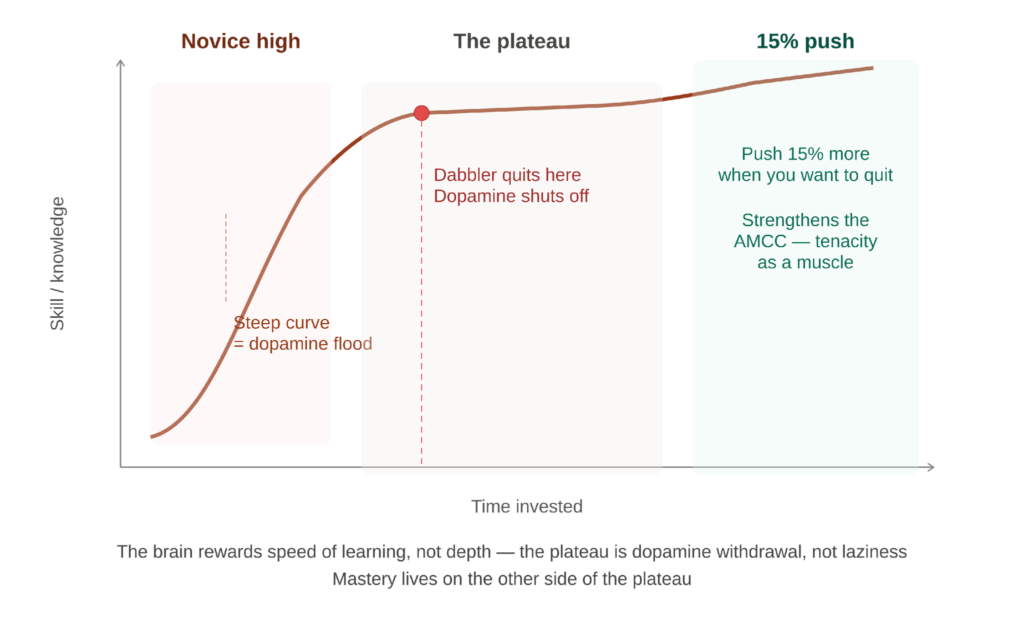
Figure 3: The dopamine-driven novice high, the plateau where dabblers quit, and the 15% push that builds tenacity.
When you begin learning something new, the brain floods with dopamine. The learning curve is steep, every session brings visible progress, and the sensation is genuinely pleasurable. Researchers call this the novice high. The brain is driven by a knowledge instinct — a drive to reduce uncertainty — and for some people, the brain is more sensitive to the speed of acquiring knowledge than to the knowledge itself.
Then the curve flattens. Progress becomes invisible. The gap between sessions feels like nothing happened. This is the plateau, and it is where most people stop. The dopamine supply shuts off, and what feels like laziness is actually something more precise: it is dopamine withdrawal. The brain has been conditioned to expect a reward for learning, and when the reward disappears, the motivation disappears with it.
The dabbler quits here. Not because they lack talent, but because they lack the neurological infrastructure to persist without the dopamine signal. This infrastructure lives in a specific brain region: the anterior midcingulate cortex (AMCC). The AMCC activates when you do something you do not want to do. It is, in a very real sense, the muscle of tenacity. And like any muscle, it atrophies when it is not used.
The practical implication is the 15% push rule. When you feel the urge to quit — when the dopamine has dried up and the plateau feels endless — push to do just 15% more. If you planned to read ten pages and want to stop at three, read one more. That single page is the repetition that strengthens the AMCC. Over weeks and months, the muscle grows, and the plateau stops being the place where you quit and starts being the place where you build.
For individuals with ADHD, willpower alone is often insufficient — and attempting to brute-force through the plateau can be counterproductive. External scaffolding becomes essential: task visualization, timers for time awareness, body doubling (working alongside others), and gamification to provide artificial reward signals where the brain’s natural ones have gone quiet.
Boredom Is the Gateway
There is one more obstacle that the modern world has placed between us and mastery: chronic overstimulation. Constant exposure to social media, streaming content, and notification-driven interfaces raises our baseline for stimulation. The quiet work of deep practice — reading technical documentation, working through exercises, sitting with a problem until it yields — feels intolerably boring by comparison.
The antidote is unglamorous but effective: practice stimulus control during work sessions. Put the phone in another room. Turn off the music. Allow yourself to feel the boredom. This is not punishment — it is a necessary state for the brain to shift from consumption to creation. The discomfort is the signal that the mode shift is happening.
Mastery has always required the willingness to sit with difficulty. What has changed is not the requirement but the competition. The same brain that once had to choose between deep work and staring at the wall now has to choose between deep work and an infinite scroll of perfectly optimized stimuli. The 15% push still works. But the push has to include pushing away the distractions, not just pushing through the difficulty.
The Shape That Matters
The M-shaped professional is not a new idea. Leonardo da Vinci was M-shaped. So was Benjamin Franklin. So is anyone who has ever looked at a problem in one domain and said, “I have seen this pattern before, in a completely different context.” What is new is the recognition that the modern world — wicked, volatile, boundary-crossing — actively rewards this shape in ways that kind, stable environments never did.
Building the M requires patience. It requires the willingness to commit deeply, to quit strategically, to explore broadly, and to commit again. It requires understanding that the plateau is not a wall — it is a door, and the only way through it is the quiet, unglamorous work of showing up one more time when every neurochemical signal in your brain is telling you to stop.
The shape of your professional life is not fixed. It is something you build, one pillar at a time, with the connecting tissue of curiosity running underneath. And the best time to start building is now.
Leave a Reply